

Nightmarish imagery. Forests on fire. Individuals attempting Sisyphean tasks day and night. All these traits can not only be found in Francis Ford Coppola’s Apocalypse Now, but also in Dante Alighieri’s classic Inferno.
Apocalypse Now follows Captain Benjamin Willard, an army assassin tasked with journeying through the Nung river from South Vietnam into Cambodia in order to locate a crazed colonel known as Kurtz. Kurtz defected from the U.S. government, electing to start his own tribe of barbaric savages deep within the heart of the jungle. The film explores themes of violence, barbarism, and the meaning of war itself.
Apocalypse Now approaches its 47th anniversary this August 15th, 2026. It is loosely based on the novella Heart of Darkness by Joseph Conrad, sharing similar concepts; most notably, Kurtz appears in the novel as a European ivory trader.
At the beginning of both Apocalypse Now and Inferno, the protagonists appear to be off their paths. Willard explains to the viewer that coming back from the war affected his mental health significantly, and he could not adjust to civilian life. He divorced his wife and went back to Vietnam, where he finds himself having an alcoholic episode in his flat in Saigon. It is clear that, without a mission, Willard is struggling to find his purpose in life.
Similarly, Inferno opens with Dante stating that he “had wandered – who knows how long – from the right path of life.” He walks out into a valley full of forest, the sunshine on his face comforting him. He describes his emerging into the forest as a literal departure from “moral darkness.” It could be said that Dante’s experience in these dark woods is a physical manifestation of Willard’s mental state, both feeling off kilter until they come across their mission or task.
While Willard is tasked by the army to find and assassinate Colonel Kurtz, Dante is tasked by his true love Beatrice to develop his relationship with God by witnessing the punishment of sinners. In this regard, the two characters are in contrast, as the way their struggles are triggered is vastly different. Dante’s straying from God is only mentioned at the beginning of the first canto, (chapter,) and is vaguely alluded to for the rest of the book.
Willard’s mental instability is clear, and one of the first scenes we see him in involves him accidentally cutting himself on a piece of mirror while throwing himself around a hotel room. He wrestles with his purpose as a killer, possibly contributing to his emotions towards Kurtz due to his role as a similarly government trained murderer. During his journey to Kurtz’s compound, he frequently ponders what exactly he will say to Kurtz once he meets him.
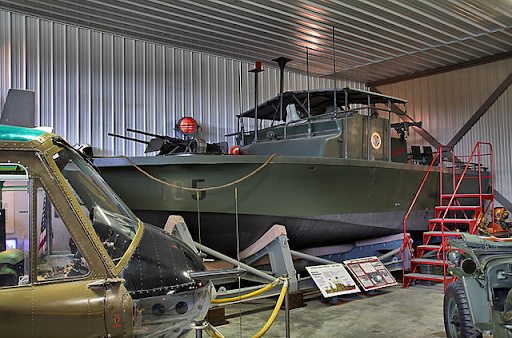
Apocalypse Now features several nuanced side characters. Willard is accompanied by sailors Chief Petty Officer George Phillips, Jay “Chef” Hicks, Lance B. Johnson, and Tyrone “Mr. Clean” Miller. Each of these characters have their own unique roles in Willard’s journey. Phillips is a no-nonsense boat captain, who is dedicated to his job and protective of his boat. Chef is a comedic, everyman kind of soldier who just wants to survive the war, and Lance is a professional surfer who becomes detached from reality with his use of drugs. Mr. Clean is a young man barely the age of enlistment, who still acts like a kid. He is played by Laurence Fishburne, who actually lied about his age to be in the movie; he was 14 at the start of filming. His youth is a strong representation of how many young men were sent to their deaths in Vietnam.
(Photo Credit: John Schanlaub from Lafayette, IN, USA, CC BY 2.0 <https://creativecommons.org/licenses/by/2.0>, via Wikimedia Commons)
Towards the middle of the story, Willard, Phillips, Chef, Lance, and Clean are dropped on the middle of the river by Kilgore and his helicopters. They travel through day and night, floating along the lone path to Kurtz. At one point, Willard and Chef dismount from the ship in order to find some mangos, and wander into the jungle. In the rainforest, Chef tells Willard of how he earned his nickname, serving as a cook in his hometown of New Orleans. His exposition is interrupted by the appearance of a wild tiger that attacks the duo and causes them to sprint back to the boat; this causes Chef to say the iconic line “Never get out of the boat.”
While this scene is a perfect example of the dangers of the jungle, and the environment the soldiers are thrusted into at such a young age, the scene also draws significant parallels to Inferno. In Inferno, Dante wakes up in a dimly-lit forest by himself, and is confronted by three beasts: a lion, a she-wolf, and a leopard. The lion represents pride, the leopard represents lust, and the she-wolf represents greed. Both protagonists of both stories find themselves confronting animalistic representations of their greatest opponents, the tiger in Willard’s possibly representing the will of the jungle or the horrors he is yet to see figuratively sheathed in darkness.
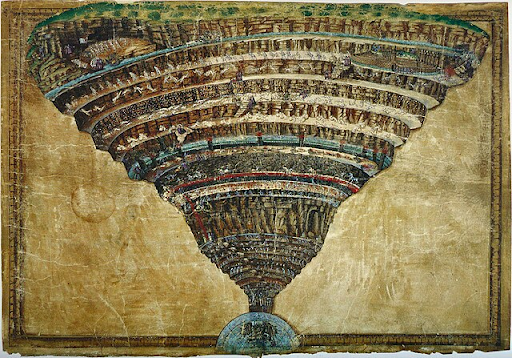
In Inferno, the main antagonist is obvious. Lucifer lies in the ninth circle of Hell, towards the very center of treachery. Dante describes him as being in the middle of a frozen lake, surrounded by fellow traitors stuck in place halfway through the ice. He has three heads, and his batlike wings create the three winds that keep the lake at its freezing temperature. In Apocalypse Now, Kurtz could be considered analogous to Lucifer, the very end of Willard’s and Dante’s journeys in the underworld respectively. Kurtz too lies amongst his disciples, choosing to reside in an ancient temple on the riverbanks of the Nung River. His army of natives worship him like a god, and dismembered bodies are strewn about the place haphazardly.
In a sense Kurtz fits the criteria for the ninth circle of Hell perfectly. Kurtz went rogue from the United States Military, choosing to establish his own force against the Viet Cong in the jungle; this is similar to Lucifer leaving the grace of God, taking other angels with him to live in Hell. Both individuals choose to leave what could be considered civilization for savagery; they make this trade for something they consider more important, that being agency.
Kurtz abhors the Marines despite almost making the position of general, as he finds them to be hypocrites. As he tells Willard during his captivity, the government sends young men to kill the Viet Cong, but prevents them from putting curse words on their airplanes because it is “obscene.” They also claim to be dedicated to winning the war, yet lack the conviction needed to commit the atrocious acts the Viet Cong commit daily. Colonel Kurtz rejects these beliefs, opting to embrace war in the same spirit of his enemies. Willard, like Dante, is sent down by their leader to bear witness to the works of their enemies; Willard however, is moved to kill Kurtz. To a certain extent, Dante too is “killing” Satan, as he makes this journey in order to expel sin from his heart.
The imagery in these two stories is striking. One of the most iconic shots in Apocalypse Now is when Lieutenant Bill Kilgore and his fleet of helicopters are sailing through the sky to the sound of ‘Ride of the Valkyries’ by Richard Wagner; this scene contrasts the brutality and industrial nature of the helicopters to the elegance of classical music. Another scene shows a gruesome battle at Do Long Bridge, a checkpoint Willard and his crew must pass in order to meet Kurtz. A tattered and destroyed bridge is framed by a string of lights, while Viet Cong and Americans trade bullets and screams across the river. It is night, and the only source of illumination is fire. The scenery in this point in the movie could be a parallel to any scene in Inferno; the darkness, flames, and utter chaos erupting evoke a distinct sense of Hell.
Furthermore, the point the scene seems to make draws similarities with the concept of divine punishment in Inferno. A young soldier fighting at the bridge remarks that they have been rebuilding this bridge every day, only for the Viet Cong to dismantle it at nightfall. Trying and failing over and over, these soldiers are allegorical to the labors characters like Sisyphus and Tantalus endure in their time in their own underworlds. The difference between the soldiers and the damned however, is that the damned deserve their punishment in the context of their stories. The American soldiers are sent to Vietnam due to either being drafted by their government or their innate need to serve their country, while the Viet Cong are fighting for both their beliefs and out of a necessity for survival.
The impact of Apocalypse Now on pop culture is undeniable. The piece ‘Ride of the Valkyries has become synonymous with grandiosity and intimidation, and is often referenced in modern media. The movie was inducted into the National Film Registry in 2000, ironically being praised by the government it criticized. However, the movie’s message has seemingly reached more of the general public. The movie was a stark criticism of the savagery of war, and despite its historical inaccuracies it captured the mood of the Vietnam War perfectly. The visuals and imagery are unparalleled in their striking appearances, bordering on a psychedelic fantasy. It also spread awareness on the brutality and pointlessness of the Vietnam War, and made audiences identify with the various side characters in the film; this made their deaths even more shocking and impactful.
Apocalypse Now approaches its 47th anniversary this August 15th, 2026. It is loosely based on the novella Heart of Darkness by Joseph Conrad, sharing similar concepts; most notably, Kurtz appears in the novel as a European ivory trader.