
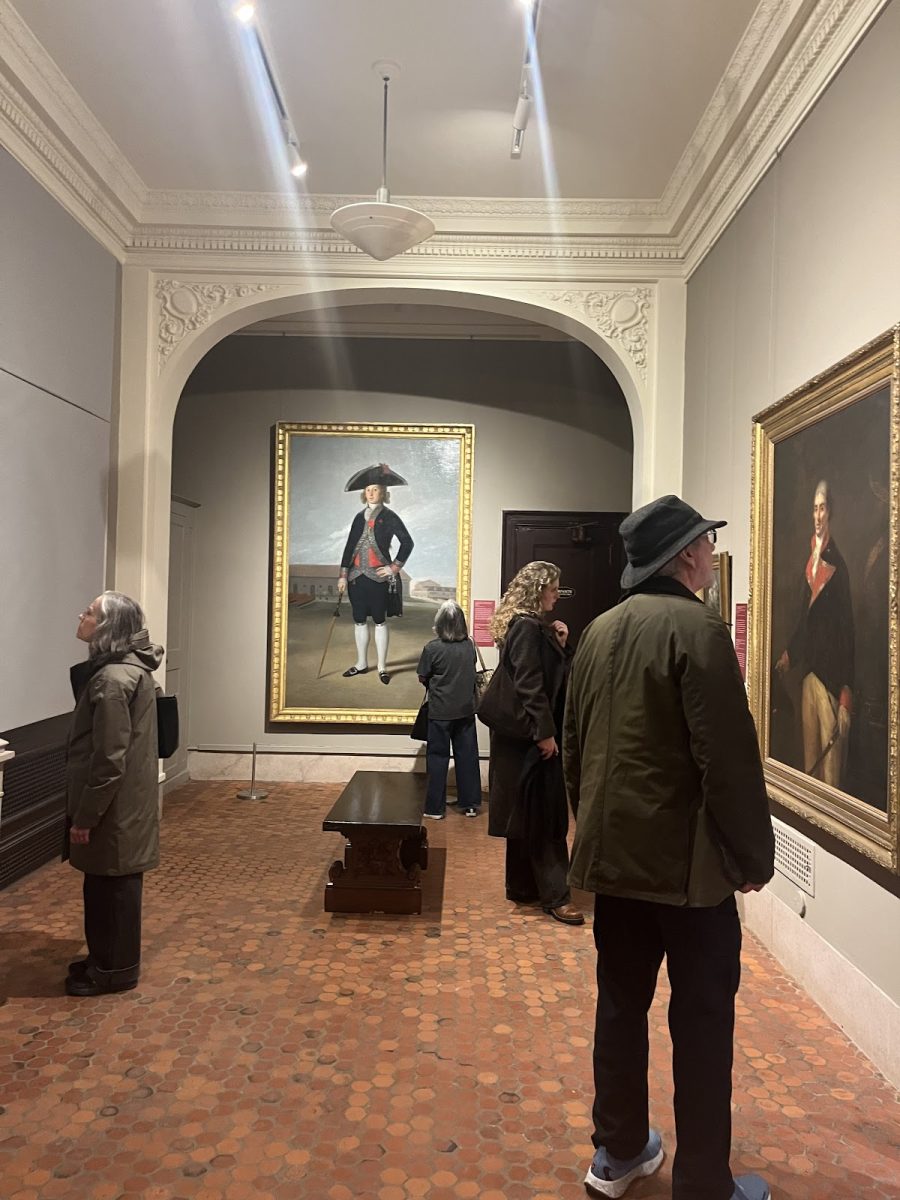
Upon merely stepping into the foyer of the Hispanic Society Museum & Library, the air around you changes. Walk twenty feet forward, cross the threshold from the entryway into the exhibition rooms, and enter the time machine that is this museum. After setting foot in the gallery, I was no longer a high school student visiting a museum in the heart of modern-day New York City, but rather a Spaniard strolling through a royal art collection during the height of the 18th century. Around me, ornate terracotta columns and arches lined the walls of the main room, or what the museum calls the ‘Renaissance Courtyard,’ an exhibition space that is currently highlighting the fashions of the Spanish Renaissance.

But instead of stopping there, I was compelled to take a left down an elaborate arched passageway. Before I knew it, I had stumbled into a white room with arches of its own, portraits and battle scenes sparsely strewn across the walls; the room is dedicated to Goya and the Age of Revolution, currently on view through Sunday, June 28th, 2026.
Francisco de Goya y Lucientes (1746-1828 C.E.), a Spanish Romantic painter and printmaker, is widely regarded as the last of the Old Masters and one of the first great artists of the modern era. His artistic career with the Spanish Crown began in 1775, when he was commissioned to paint a collection of over 60 tapestry cartoons (preparatory paintings) depicting the contemporary lives of the aristocracy. These works were designed to be woven into tapestries for the royal palaces of El Escorial and El Pardo.
Throughout the seventeen years that this assignment spanned, Goya began to adopt his own style, breaking free from conformity and from traditional artistic purposes. One of the last paintings in this series of cartoons, Chicken Fights, uses a children’s game as a pretense for subtly critiquing the tense state of the government. Goya’s transition towards using art as a means for exposing injustice was heavily influenced by Diego Velázquez (1599-1660 C.E.), a prominent realist painter whose art frequently reflected the conditions of the world around him.
In 1792, an illness left Goya permanently deaf. Literally unable to hear any external criticism, Goya’s art began to truly embody his freedom of expression, allowing him to further reveal injustice in society.
Across Europe during the 17th and 18th centuries, war was a glorious act. To fight for your country was considered an honor, not a death sentence. Spanish Habsburg monarchs at the time desired ‘gloire,’ the fame that came with military victory, above all else to further consolidate their power, promoting war as a necessary and noble pursuit.
The rise of nationalism further glamorized war, convincing the people that they needed to fight for their country in order to achieve justice, prestige, and superiority.
However, war is far from glorious. It’s bloody, painful, and heartbreaking. Goya expertly captures the realities of war in his series of 82 etchings, labelled the Disasters of War, from 1810 to 1820.
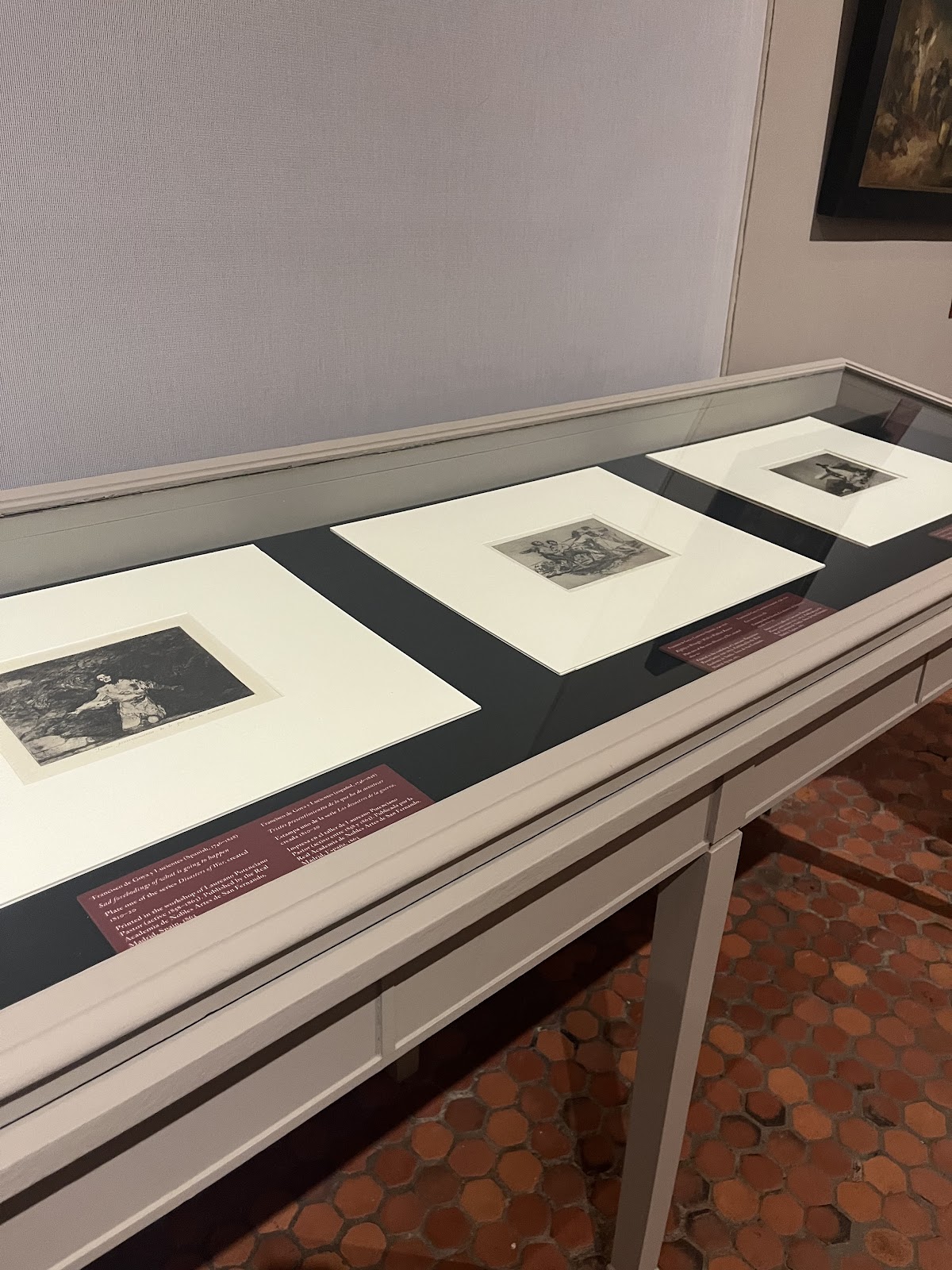
These prints depict the duality between heroism and atrocity during the Peninsular War fought between 1808 and 1814 C.E.. This war, triggered by Napoleon’s invasion of the Iberian Peninsula, was fought by Spain, Portugal, and the United Kingdom against France’s invading forces. The Peninsular War was a brutal, guerilla conflict of savage fighting on all sides, and is the bloodiest event in modern Spanish history.
Goya found himself caught in the middle of it all, witnessing horrors he could have never imagined before. At one point, Goya may have just been a man who painted the daily life of aristocrats, but after experiencing this violence firsthand, watching the city around him burn, he was not the same painter. He was no longer romanticizing the lives of the one percent, but now revealing the treacherous, yet common experiences of the Spanish commoners.
Three of these revolutionary prints are on display at the Hispanic Society Museum’s Goya and the Age of Revolution exhibition. The prints, With or Without Reason, How Brave! and Sad Forebodings of What is Going to Happen, are vivid illustrations of what was actually happening on the frontlines of the Peninsular War.
Without cameras to capture events as they were, many people were left unaware of the realities of war. Goya opened the eyes of the Spanish people through his art. Every scratch of his etching needle revealed a crumb of the harsh truth that the Spanish people had to swallow.
Rather than using these prints as a means for propagating Spanish nationalism, Goya portrayed all sides of the story, overturning traditional views of combat. By choosing to not use identifying features from soldiers on either side of the war, Goya blurs the line between victim and perpetrator. Instead of steering viewers towards division, these prints united the Spanish and French alike under an anti-war ideology.
However, not all of Goya’s work expresses such neutrality. Most notably, Goya’s painting The Third of May, 1808, at the Prado Museum, depicts the French execution of Spanish rebels. Goya paints the Spanish freedom fighters no longer fighting, but rather helpless, defenseless, and surrendering to the French soldiers pointing guns to their faces.
Unlike with the Peninsular War in his Disasters of War series, Goya never actually witnessed the Third of May massacre firsthand. The fact that Goya wasn’t a firsthand witness to the event, combined with the fact that his painting fueled Spanish hostility towards the French, renders Goya’s depiction of events not entirely reliable nor unbiased.
Goya’s bias exists within the walls of the Hispanic Society Museum as well. Besides the pastiche of Goya’s Third of May, 1808, several of his other paintings convey a strong sense of Spanish nationalism. On the far right wall, behind a white arched opening, lies a grand painting of a seemingly prominent man, framed in gold. Without even reading the description, you can tell the painting is the work of Goya.
Beyond his signature romantic style, every painting in the gallery that belongs to Goya is held in a specific gold frame, signifying the wealth and status of those portrayed. This painting, titled Don Manuel Lapeña, later Marquis of Bondad Real from 1799, frames Manuel Lapeña Ruiz del Sotillo, an aristocratic military officer and noble companion of the Duke and Duchess of Osuna, two of Goya’s most significant patrons. On the wall to the right, rests another gold-framed portrait of a Spanish military officer by Goya, called Brigadier General Alberto Foraster, made in 1804.
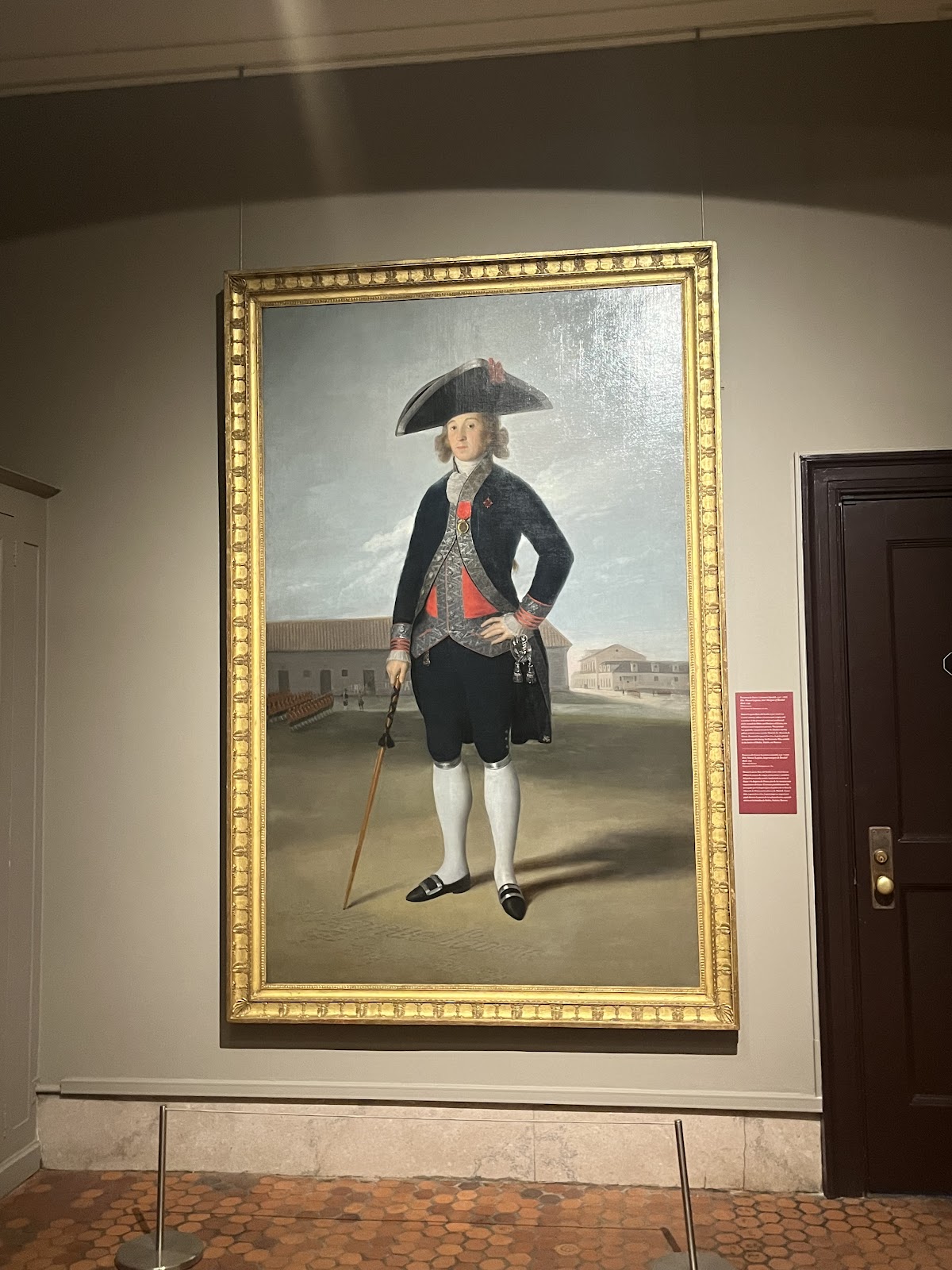
Both paintings portray Spanish military commanders as way more than what they actually were. Manuel Lapeña Ruiz, despite being named the Marquis of Bondad Real, was notoriously an incompetent general, nicknamed “Doña Manuela” or Lady Manuel, for his cowardice and lack of initiative on the battlefield. Similarly, General Alberto Foraster played a generally insignificant role in the Peninsular War. However, upon first glance, an unsuspecting viewer would probably think that the men portrayed were truly important. In the paintings, they hold sabers, clad in intricate military uniforms. Goya intentionally painted these officers in a glorious light, promoting a sense of Spanish pride and military glory.

These portraits provide such a stark contrast from Goya’s Disasters of War, despite only being made a few years earlier. This difference can only be explained by Goya’s experience of war firsthand. Making portraits of military officers and paintings of massacres in distant cities is nothing like painting the destruction right before your eyes. This is why Goya’s Disasters of War print series remains some of his most powerful works.
But these works are not just glimpses of the past; they remain extremely relevant to this day. While war is no longer glorified or romanticized, it is not entirely realized either. Especially in America, so many live blissfully unaware of the violence happening all across the world. Just recently, the U.S. launched an attack on Iran, killing over 2,100 people on all sides of the conflict and displacing around 3.2 million Iranian civilians. While the military campaign originally started to curb Iran’s nuclear power, it has quickly escalated to something else, leaving 175 elementary schoolers dead in Iran.
The attack on Iran is just one of many ongoing conflicts that endanger innocent lives across the globe. In a world plagued by violence, revolutionary works of media, such as Goya’s Disasters of War, are all the more necessary.
Looking back, what initially drew me to the Goya and the Age of Revolution exhibition was the relevance that it holds in today’s society. Visiting the Hispanic Society Museum & Library, especially this exhibit, at first feels like entering a time machine. It takes you back hundreds of years to the conflict-ridden past, and then brings you right back to the staggeringly similar realities of today.
Looking back, what initially drew me to the Goya and the Age of Revolution exhibition was the relevance that it holds in today’s society. Visiting the Hispanic Society Museum & Library, especially this exhibit, at first feels like entering a time machine. It takes you back hundreds of years to the conflict-ridden past, and then brings you right back to the staggeringly similar realities of today.