
!['Boy with a Basket of Fruit (c. 1593)' is an early masterpiece by Caravaggio that highlights his burgeoning mastery of light and naturalism. It’s a strikingly sensual work from his youth that serves as a precursor to the dramatic chiaroscuro and psychological depth that would later define the Baroque era. [Image Credit: Caravaggio (Michelangelo Merisi). 'Boy with a
Basket of Fruit, ca. 1595'. Oil on canvas
© Galleria Borghese / ph. Mauro Coen. Photography by Graham S. Haber, 2017; Reprinted by permission of The Morgan Library & Museum]](https://thesciencesurvey.com/wp-content/uploads/2026/03/Caravaggio_Boy_with_Basket_of_Fruit-1153x1200.jpg)
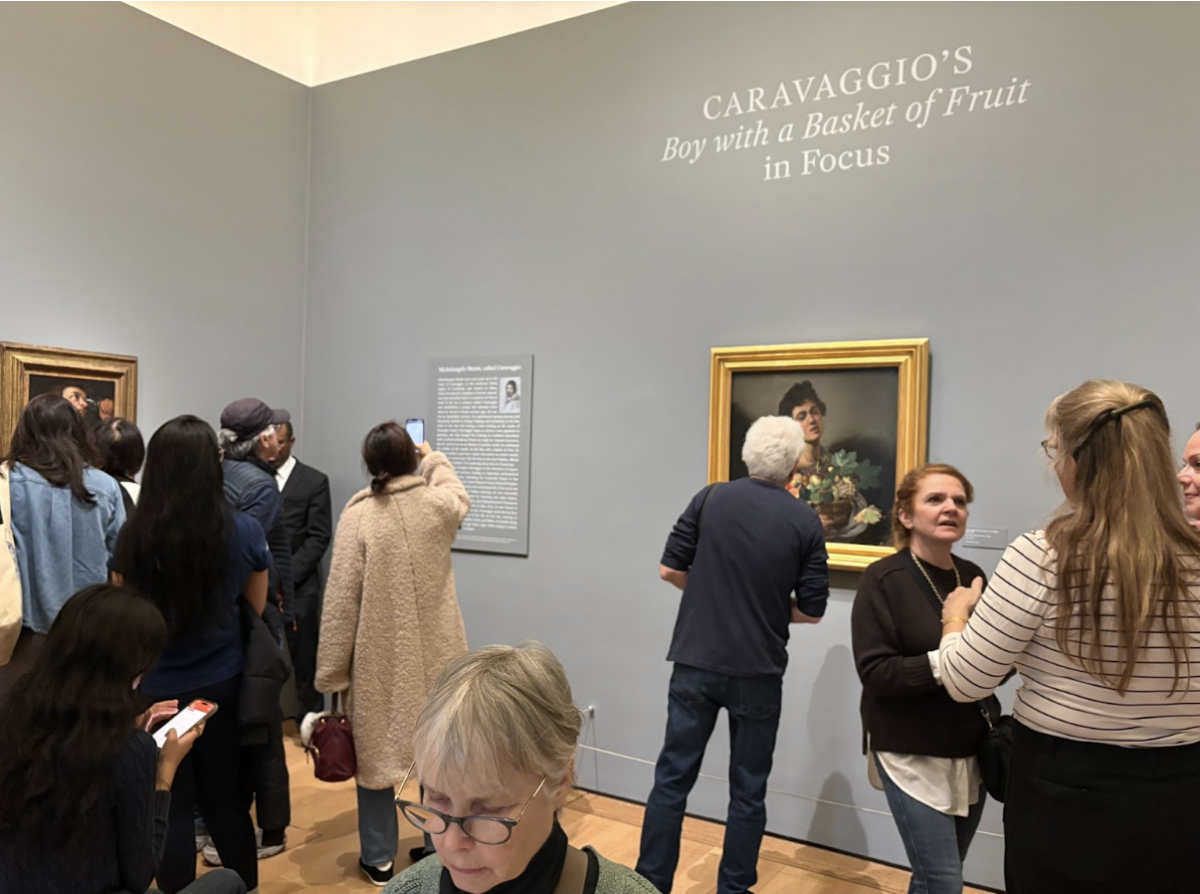
Beyond the crowded streets of Manhattan, where traffic presses forward and conversations overlap in constant motion, the galleries of The Morgan Library and Museum offer a sudden solitude. Within the quiet galleries, a teenage boy meets the viewer’s gaze with almost an unsettling directness. Painted more than four centuries ago, Boy with a Basket of Fruit by Caravaggio feels surprisingly immediate. The fruit tilts toward the edge of the canvas, each leaf and bruise on the fruit rendered with a hushed form of confrontational realism. The boy’s expression is harder to place. He is neither inviting nor distant. This ambiguity is part of the painting’s power.
The painting is currently on a rare loan from the Galleria Borghese in Rome, Italy, and it is on view at the Morgan through Sunday, April 19th, 2026.
When Caravaggio arrived in Rome around 1592 as a young, unknown, artist, he was entering a crowded and competitive world. The motivation behind Boy with a Basket of Fruit likely was a calculated attempt to stand out, rather than simply a show of technical skill. By combining striking naturalism with uncertainty, Caravaggio created an image that demanded attention, both in his time and ours.
To understand why the painting feels so direct, you have to look beyond the painting and to the artist. Caravaggio was born Michelangelo Merisi in 1571 C.E. and raised in Lombardy, Italy, later moving to Rome to pursue a career in painting. Much like modern New York, Rome at the turn of the seventeenth century was a city alive with ambition, reinvention, and relentless artistic competition. Caravaggio responded not by imitating the graceful idealism of the Renaissance, but by rejecting it. He painted from life. Caravaggio used ordinary models. He emphasized dirt, bruised fruit, wrinkled fabric, and human vulnerability. The sharp contrast between light and dark, known as chiaroscuro, heightened the dramatic effect and focus of the art, drawing in the viewer rather than keeping them at a distance.
On the other hand, Caravaggio’s rise in Rome was rapid, but so was the chaos that followed in his wake. After arriving as a virtually unknown artist, he gained attention from influential patrons and began receiving major commissions for projects ranging from churches to private collections. His somewhat avant-garde artistic style, once risky, quickly became highly sought after. Yet his turbulent personal life grew increasingly unstable and distracting to his artistic career. In 1606, after killing a man in a fight, Caravaggio was forced, under penalty of death, to flee the city where he had launched his artistic career. His rise and fall did not happen in isolation; it unfolded at a moment when Rome itself was redefining what art could be.
Just as modern New York thrives on reinvention and self promotion, Rome was undergoing its own artistic shift. The calm harmony of the Renaissance was giving way to a new visual language that favored intensity over perfection.
This approach aligned closely with the emerging Baroque style, which arose in the late sixteenth century. Baroque art emphasized realism, movement, and emotional intensity over the Renaissance style characterized by calm balance and perfect beauty. It sought to engage the viewer directly, often blurring the boundary between the artwork and observer. Rather than standing safely outside the scene, the viewer feels pulled into the same space as the boy, meeting his steady gaze at eye level. In that shifting artistic climate, Caravaggio’s bold naturalism worked to not only reflect the moment in art, but also to define it.
That sense of artistic risk and reinvention is central to how the painting is presented today. At the Morgan Library & Museum, the Boy with a Basket of Fruit is not treated simply as a familiar masterpiece, but instead as a calculated act of self invention. Dr. John Marciari is the Charles W. Engelhard Curator, Department Head of Drawings and Prints, and Director of Curatorial Affairs at the Morgan Library & Museum, and he curated this exhibition. Dr. Marciari explained to me in an interview, Caravaggio was “a new artist. He’s just arrived in Rome from the North. No one knows who he is. He’s trying to do something that stands out in a crowded city.” The painting, in that sense, had strategic value. It was made, Dr. Marciari notes, “for open market,” a new phenomenon beginning in late sixteenth century Rome. Instead of fulfilling a specific commission, Caravaggio created it ‘on spec,’ hoping to attract buyers and to establish a name for himself.
Seen up close in the Morgan’s small, focused gallery, that ambition feels almost palpable. The gaze of the boy featured in the painting does not soften under scrutiny; it intensifies. The curator described the effect as an “awareness of a spectator,” an attempt to “shatter the picture plane.” The illusion that the view stands safely outside the scene begins to disappear. Instead, the painting draws attention to itself as a constructed object, almost asking the viewer to question exactly what it is that they are seeing.
The ambiguity featured appears deliberate. “I think it’s meant to open questions rather than answer them,” Dr. Maciari said. Is the boy a mythological figure? An allegory? Simply a model posing? The uncertainty is part of the work’s lasting tension. Even interpretations that emphasize symbolic meaning or sensual undertones, the curator suggests, may miss the larger point. During our interview, the curator proposed a different approach: instead of dissecting the painting on our own terms, we might better understand it by considering what Caravaggio himself set out to accomplish.
The tension between these interpretations reflects a larger shift taking place in art at the time. Painters were beginning to move away from images that simply illustrated clear moral or religious messages and toward works that engaged with viewers directly. Instead of providing a fixed meaning, artists increasingly allowed space for interpretation, emotional response and even uncertainty. In that sense, Caravaggio’s painting operates almost like a visual question. The boy’s steady gaze, the imperfect fruit, and the intimate scale of the composition invite the viewers to examine the scene closely while leaving its full meaning unresolved.
A French and Italian teacher and former A.P. Art History teacher at the Bronx High School of Science, Mr. Walter Giorgis-Blessent, echoed this idea of international ambiguity but framed it within Caravaggio’s broader approach to reality and human experience. Mr. Giorgis-Blessent told me to emphasize how the boy and the imperfect fruit resist idealization, insisting that the spots on the fruit and the wilting of its leaves were not mistakes but instead deliberate markers of life’s transience. “It’s about the passing of time and a kind of memento mori. ‘Memento mori’ translates to “reminder of death,” Mr. Giorgis-Blessent explained. By placing a seemingly ordinary boy from the street at the center of his painting, Caravaggio challenges viewers to confront the real world rather than an imagined one. This approach aligns with what the curator Dr. Marciari said about open-ended questions. Both highlight how Caravaggio foregrounds human presence and emotional realism over neat allegory.
The spotlight effect — what later becomes his signature use of chiaroscuro — further amplifies this realism by drawing attention to subtle textures, shadows and the quiet tension in the boy’s gaze. In this way, the Boy with a Basket of Fruit is able to do more than just depict; it invites the viewer to have a connection to the piece, much like the experiences of entering the Morgan’s intimate galleries from the busy streets of Manhattan.
Seen this way, Boy with a Basket of Fruit becomes much more than an early experiment in naturalism. It becomes a calculated moment of an artist’s self-definition. Caravaggio was not just painting a boy with a basket of fruit; he was announcing himself to the Roman art world. The ambiguity, the connection with the viewer, and the deliberate realism all served that purpose.
Standing in the quiet gallery at the Morgan Library & Museum, the results still resonate. The boy’s gaze remains steady, the fruit still threatens to slip from the basket, and any questions that the painting raises remain unanswered. Four centuries after Caravaggio first tried to make his name in the crowded city, Boy with a Basket of Fruit continues to do exactly what it was designed to do, to capture attention and to refuse to let the viewer look away.
“He’s a new artist. He’s just arrived in Rome from the north. No one knows who he is. He’s trying to do something that stands out in a crowded city, and so he makes a painting that is slightly confrontational because of its unusual qualities,” said Dr. John Marciari, the curator of the exhibition.