
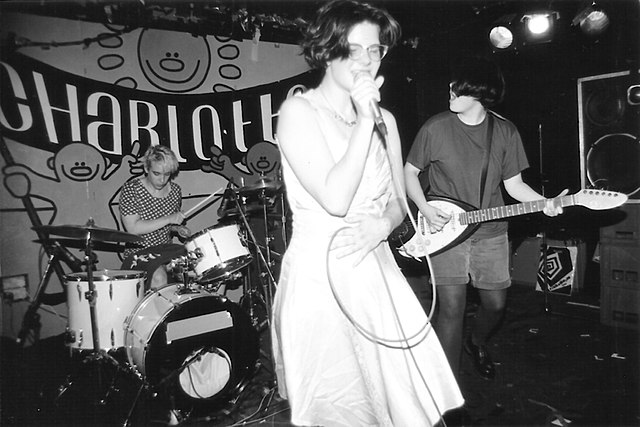
Punk is a major genre since the seventies, rooted in rock ‘n’ roll, and characterized by loud, rebellious music that takes a stand against societal norms. This genre, now used as a way for marginalized groups to spread their voice, was once restricted for women.
Women had endured rampant sexism for centuries, and now a music scene dedicated to destroying social norms was following the oldest social norm of all, that women aren’t equal to men. And so, the band Bikini Kill (formed in 1991) sparked the Riot Grrrl movement.
Riot Grrrl slapped societal norms in the face, showing how loud, harsh, and abrasive women could be. “Peace, love and equality, your terms I don’t fit into your f*cking words,” Kathleen Hanna, the singer of Bikini Kill, famously sung in their song ‘Blood One.’ Their music encapsulated the rage that women had accumulated over the years without sugarcoating reality. When Bikini Kill performed onstage, Hanna would expose her breasts and rear-end, wear girlish ponytails, and unapologetically exaggerate aspects of womanhood praised by society.
The movement didn’t come out of nowhere. Conservatism was on the rise after the Cold War, with presidents such as Ronald Reagan and George H.W. Bush promoting traditional family values. Consequently, the mass media viewed feminism as obsolete and excessive. Emerging after the 1991 Anita Hill testimony, where Anita Hill testified against the judge Clarence Thomas for sexual harassment, Riot Grrrl proved to be an early manifestation of third wave feminism. It was born out of the need to fight back these long established ideas as well as tackle existing problems, such as gender-based violence and systemic bias, that plague women in this age.
The third wave of feminism — beginning in the early 1990s until the 2010s — emerged because of the shortage of women in positions of power as well as prevalent sexual assault in the workplace. It contrasted the second wave of feminism by shifting focus from broad female experiences (often only including white, privileged women), to embracing intersectionality and actively seeking to be multicultural, sexually diverse, and inclusive. These principals were deeply connected with Riot Grrrl as their music was made to address the general problems women face with challenging patriarchal oppression.
Another significant factor of the movement was its geography. Riot Grrrl was made possible through the institutional, cultural, and social conditions of Olympia, Washington, where the movement began. The small town had an unusually strong independent music economy, with an abundance of house shows, small venues, and cheap rehearsal spaces. The close-knit networks meant rapid circulation of ideas, face-to-face organizing, and overlap between musicians and activists.
Someone who helped get Riot Grrrl started was Calvin Johnson, the founder of K Records which organized International Pop Underground (IPU). As a lover of underground music, he wanted to boost unknown bands and artists to a wider audience; he exceeded these goals. The organization became popular enough that K Records hosted a week-long convention featuring a variety of independent artists, inspiring the DIY aesthetic, and fostering unity against corporate capitalism. One night was dedicated to Riot Grrrl bands, officially titled “Love Rock Revolution Girl-Style Now.” This significantly increased the Riot Grrrl movements following, and motivated them to continue spreading their message.
In an era of no social media, Riot Grrrl gained traction with zines — small magazines that depict art and messages. Women wrote and drew about rape, sexual abuse, harassment, discrimination, and more women’s issues that plagued the world daily. Zines were incorporated in magazines, flyers, and posters, allowing women’s voices to finally be heard as well as increasing the popularity of Riot Grrrl.
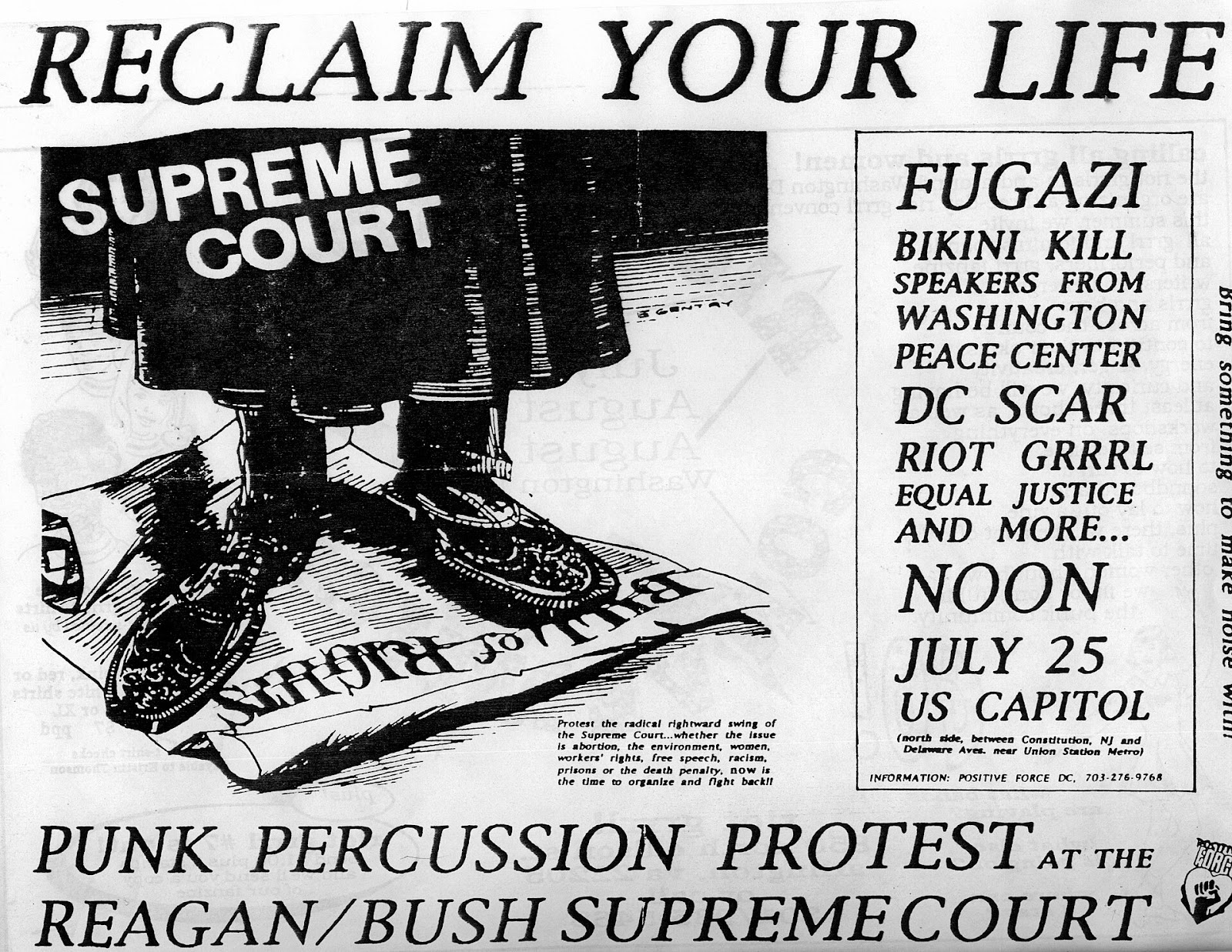
Another way that Riot Grrrl gained popularity was through Ladyfest, a global music fest for women artists. In 1999, Allison Wolfe, the lead singer of the Riot Grrrl band Bratmobile, organized the first Ladyfest in Olympia. The first festival featured Bikini Kill, The Gossip, Slumber Party, and many other Riot Grrrl bands. In addition to live music, there were also a variety of workshops which ranged from screen-printing to crocheting, promoting the DIY aspect of Riot Grrrl. Ladyfest made its mark, branching globally and still continuing today.
However, as Riot Grrrl became more mainstream, there was backlash. The movement was misrepresented, framed as violent and “from the streets.” The “taboo” topics that were discussed in zines and music threatened men and women alike as it shattered their reality and forced them to see the harsh truth of the difficulties minorities face day-to-day. Journalists took quotes out of context, focusing on superficial topics like fashion over politics, and portrayed artists as caricatures, fueling the anger felt by the masses towards women’s resistance.
In 1992, Riot Grrrl initiated a complete media blackout to try to take control of the narrative, but unfortunately, the movement didn’t last forever. Riot Grrrl eventually faded in the late 1990s, with the disbanding of influential bands like Bikini Kill and internal conflicts, but its influence continues to this day. Bands like Destroy Boys, Mommy Long Legs, VIAL, and Be Your Own Pet continue the Riot Grrrl legacy. While times have changed, women’s issues are still a persistent problem, and more and more artists are using their voices to discuss them.
This DIY culture of punk movements is now lost in the modern age. With social media apps such as TikTok, Instagram, and YouTube, bands and independent artists can easily advertise their music to wide audiences. While this does make it easier for people to find smaller musicians without record labels or big production companies, zines are no longer in the mainstream. Creativity has been replaced by easy, attention grabbing tactics used by many influencers. Riot Grrrl made itself distinct by their use of zines and art to spread awareness to women’s issues, and their musical success and artistic culture would not be the same today in the digital age.
“Music amplifies my emotions, and particularly with Riot Grrrl music, there’s a definite effect on my emotions the second that I hear it,” said Ariana Wayne Libovich ’28 when asked how music affects her. Riot Grrrl has definitely made its mark, and although it originated in the 1970s, the youth still listens to the powerful voices of these women who weren’t afraid to be themselves. “You can make people feel something in a way that just an image or essay can’t,” Libovich adds. “I don’t think it can necessarily replace other forms of protest, but I find it a really good outlet and way to connect over an issue.”
Riot Grrrl is distinctive, powerful, and unique towards women’s struggles. It isn’t just a short flash in history; this genre has sent an unforgettable message to the world. “I do listen to a little bit of Riot Grrrl, and I enjoy the straightforward, strong lyrics. The songs that I’ve heard in the genre often have vulnerable but important topics that the listeners relate to, or address important issues in the world. It feels more personal to listen to music made by people who share my thoughts, ideas, and struggles, especially since the genre is directed towards girls,” said Moksha Mulchandani ’28. As long as sexism exists, these messages have to get across to women and girls to show that they are not alone in their struggles and that change can be made with enough determination.
“Music amplifies my emotions, and particularly with Riot Grrrl music, there’s a definite effect on my emotions the second that I hear it,” said Ariana Wayne Libovich ’28 when asked how music affects her.