
A fair, blond-haired child no more than five years old is wrapped from chest to toe in a white blanket. She sits with rosy cheeks and wide eyes, facing a large wooden table, and rests in a rattan rocking chair. She is painfully delicate. Her gaze is fixed on a budding branch, its form simple but deliberate against the flat plane of the table. The scene is suspended, restrained, almost unnaturally quiet.
“How does she capture that innocent look?” an onlooker muses aloud, studying the canvas.
This is Helene Schjerfbeck’s The Convalescent, a painting that reflects the artist’s own childhood, much of which she spent sedentary after permanently injuring her hip at the age of four. During this time, her father—an amateur painter—gave her pencils, paper, and crayons, sparking a lifelong devotion to art and introspection. That quiet, watchful child became one of the most radical painters of the twentieth century, yet she remains largely unknown on this side of the Atlantic.

Until Sunday, April 5th, 2026, the Metropolitan Museum of Art is introducing American audiences to her work with Seeing Silence: The Paintings of Helene Schjerfbeck, an exhibition tracing the artist’s evolution from academic naturalism toward a stripped, modern style that prioritized composition, surface, and suggestion over individual likeness. In her home country of Finland, Schjerfbeck is a household name. This exhibition offers Americans a rare chance to discover why.
Born in Helsinki in 1862, Schjerfbeck was the third of five children born to Svante Schjerfbeck and Olga Johanna Printz. She arrived just after her Swedish father went bankrupt, a financial collapse that had uprooted the family. After injuring her hip in 1866, Schjerfbeck struggled to walk and was educated at home. Her homeschool teacher recognized eleven-year-old Schjerfbeck’s talent and enrolled her pupil in drawing classes free of charge. The death of her father two years later further narrowed her world, pushing her inward toward art.
At the time of her adolescence in the late 1870s, the epicenter of the art world was Paris, France. And Schjerfbeck desperately wanted to be there. So, in 1880 17-year-old Schjerfbeck undertook an ambitious project: producing Wounded Soldier in Winter Snow. The work demonstrated her talent as a serious artist—the snowy landscape demanded a high level of technical skill that Parisians recognized. This was Schjerfbeck’s first historic painting, significant because at the time, large-scale historical paintings were seen as the highest form of art. Moreover, her painting was a resounding success. Not only was it acquired and displayed by the Finnish Art Society, but it bought her a ticket to Paris courtesy of the Finnish Senate.
Schjerfbeck in Paris: Tradition, Rebellion, and Possibility
The Paris art scene in 1880 favored academicism, the reigning principle of the premier art school, École des Beaux‑Arts and the most prestigious gallery, the Paris Salon. Academic art is characterized by classical techniques, technical precision, historical-mythological subjects, and idealized beauty.
However, at this time, Impressionism was gaining visibility, causing a furor among the Parisians. Impressionism broke almost every rule in academic art: painting the modern, ordinary life, working outdoors, featuring discernible brushstrokes. The movement was shunned by the Paris Salon, classified as radical.
Schjerfbeck did not attend the École des Beaux‑Arts. Instead, she attended the Académie Colarossi in 1881. The Académie Colarossi, known for its progressive policies of enrolling female students, was newly founded and gradually establishing its identity as a modern alternative to the conservative, all-male École des Beaux‑Arts.
As a seventeen-year-old who was largely sheltered in her home in Helsinki, coming to Paris broadened her world. It exposed her to the art currents of the time: the battling ideologies and forms. During this formative period, a professor and French painter named Raphaël Collin at her school was exploring Japonsime (Japanese aesthetics). This would later influence the style of a few portraits of Schjerfbeck’s such as Self Portrait with Silver Background (1915) in which Schjerfbeck wears a kimono-like garment.

At age 21 in 1883, Schjerfbeck stayed in the picturesque village of Pont-Aven in Brittany, France for several months. During her stay, she joined a group of local artists around Paul Gauguin. The group sought ways to overcome Impressionism, in order to create a new style for expression. In Brittany, Schjerfbeck started to really experiment with her own style in her bold painting, The Door (1884).

Between Acclaim and Exhaustion
By the time Schjerfbeck was in her twenties, Schjerfbeck had experienced significant success in the art world. At age 21, she made her debut onto the international stage with her piece Fete Juive accepted into the Paris Salon. Her success led to a teaching position at a drawing academy in Helsinki in 1884, and, more importantly, commissions from the Finnish state that led her across Europe.
Schjerfbeck visited St. Ives, England twice, once in 1887 and another in 1889. During her first trip to St. Ives, she was 25 and instantly enamored with the coastal English town. She described the quaint town as, “the most beautiful place I have ever seen. . . . The sea is so blue and bright. . . . The sunsets are glorious.” It was perhaps her love for this town that drew Schjerfbeck to produce her famous piece The Convalescence in 1888. This painting would be displayed at the Paris Salon later that year, where it received a bronze medal at the World’s Fair in Paris in 1889.
Around five years after her trip to St. Ives, Schjerfbeck took a momentous trip to Florence and Fiesole for several months. This trip exposed her to the works of the Italian Renaissance. She spent her time there in museums, studying old masters like Fra Angelico. Fresco, a mural painting technique applied to freshly laid lime plaster, caught Schjerfbeck’s eye. The vibrant fragility and texture of the aged frescoes Schjerfbeck saw during her trip to Italy would later lead her to pioneering her own technique of scraping and layering paint. Her technique mimicked the look of frescoes—as shown in her piece Fragment (1904).

From 1884-1902, Schjerfbeck was an active teacher and traveler, but this took a toll on her body. Schjerfbeck’s health, which had remained tenuous since her childhood hip injury, worsened. She took long stretches of convalescence partly in Helsinki and partly in Hyvinkää, a quiet railroad town in Finland where her aging mother lived.
In Hyvinkää: The Radical Turn Inward
One of the most critical periods of Schjerfbeck’s career is the time she spent in Hyvinkää with her widowed mother in a one-bedroom apartment. After leaving her job in Helsinki, 40-year-old Schjerfbeck moved to Hyvinkää in 1902 to care for her mother and herself. Hyvinkää offered Schjerfbeck the quiet necessary to abandon traditional precepts and experiment freely with form and composition, ultimately solidifying her mature style.
It was also in Hyvinkää that Schjerfbeck met Einar Reuter in 1915—a forester, amateur artist, and writer who would become central to her life. Their meeting sparked an affectionate friendship that spanned distance and time, documented in thousands of letters exchanged between 1915 and Schjerfbeck’s death in 1946. Her 1918 portrait The Sailor (Einar Reuter) is often interpreted as a love painting—its intimacy evident in the careful rendering of his figure. When Reuter got engaged in 1919, Schjerfbeck fell ill and spent three months in the hospital. Her works became noticeably darker, and yet their correspondence never ceased.

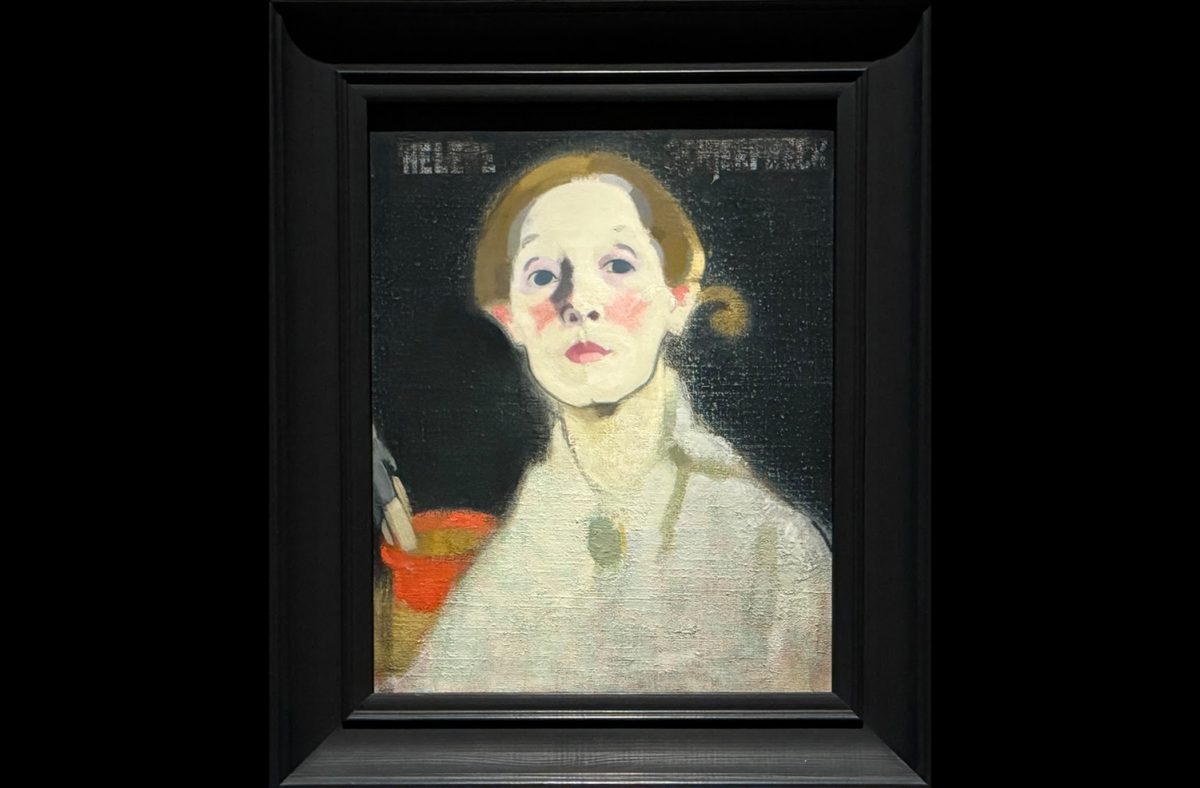
Schjerfbeck’s work from this point on has a distinct style. Her work is almost always a portrait of one or two figures. The figures are vague, fuzzy compared to art academia—they are purged of descriptive or identifying detail. To Einar Reutar, Schjerfbeck wrote, “Let us avoid executing so precisely and exactly that our work closes the way instead of opening it, let us imply.”
Notably, the figures in Schjerfbeck’s works never looked directly at the viewer—their gaze is always drawn to the side or lowered. Ironically, while Schjerfbeck primarily painted people, she found others’ presence draining. During sittings, Schjerfbeck instructed her models to keep themselves busy with activities such as sewing or reading. Schjerfbeck did this to create a distance between herself and the subject. As the curators at the Schirn Kunsthalle Frankfurt museum in Germany put it, “She used her models like mannequins she could dress with paint.”
During this period, her palette became muted, favoring shades of calming blues, greens, and greys. Schjerfbeck also stops varnishing her paintings, giving them an unfinished look. She continues playing with scraping and adding pigment to manipulate textures and color schemes.
Schjerfbeck wrote the following about her process: “I scrape out everything I have done, for it is not what I want—and when I have scraped many times what remains on the canvas is a hint of all that I have sought for and wanted, even if it is only a weak trace—or else there is nothing. The result is the sum total of my search. That is how I always work.”
As Schjerfbeck aged, her production declined. She no longer had the energy or patience for extended sittings, and so she turned inward, painting herself instead. These late self-portraits are among her most haunting works. Gone is any attempt at beauty or idealization. Her face becomes skeletal, hollowed, almost mask-like—at times scarcely human. In her final self-portraits from 1944 and 1945, she appears stunned, ghostly, and unrecognizable, as though she is already slipping beyond the physical world. They are not merely images of aging; they are meditations on disappearance.
This resignation is echoed in a letter she wrote to her Einar Reuter in November of 1945: “I have no strength left. Life has given me all it has to give.” And yet, even in this exhaustion, she continued to paint, keeping an easel beside her deathbed.

January 23rd, 2026 will mark eighty years since her death. Though she cannot speak from beyond the grave, Schjerfbeck’s paintings, letters, and life story still speak to us with startling clarity. They tell us about courage: the endurance to persist through illness, isolation, and artistic uncertainty.
She once wrote to Reuter, “Painting is difficult, and it wears you out body and soul when it doesn’t come out right—and yet it is my only joy in life.” Looking back at The Convalescent, the fragile girl transfixed by a budding branch, we realize that Schjerfbeck was always painting herself—waiting, watching, enduring. And, in the end, she found her own budding leaf.
Until Sunday, April 5th, 2026, the Metropolitan Museum of Art is introducing American audiences to Helene Schjerfbeck’s work with Seeing Silence: The Paintings of Helene Schjerfbeck, an exhibition tracing the artist’s evolution from academic naturalism toward a stripped, modern style that prioritized composition, surface, and suggestion over individual likeness. In her home country of Finland, Schjerfbeck is a household name. This exhibition offers Americans a rare chance to discover why.