
“Only that man who has offered up himself entire to the blood of war, who has been to the floor of the pit and seen horror in the round and learned at last that it speaks to his inmost heart, only that man can dance,” says Judge Holden in Cormac McCarthy’s Blood Meridian.
Cormac McCarthy’s novel Blood Meridian could be considered one of the most haunting, realistic, and impactful books of all of American literature. Cormac McCarthy’s unique writing style combined with a powerful and nuanced plot creates a book that masterfully displays the horrors of the American West during the 1800s. The story could be described as Biblical in nature, exploring a contrast between pure evil and those that serve it.
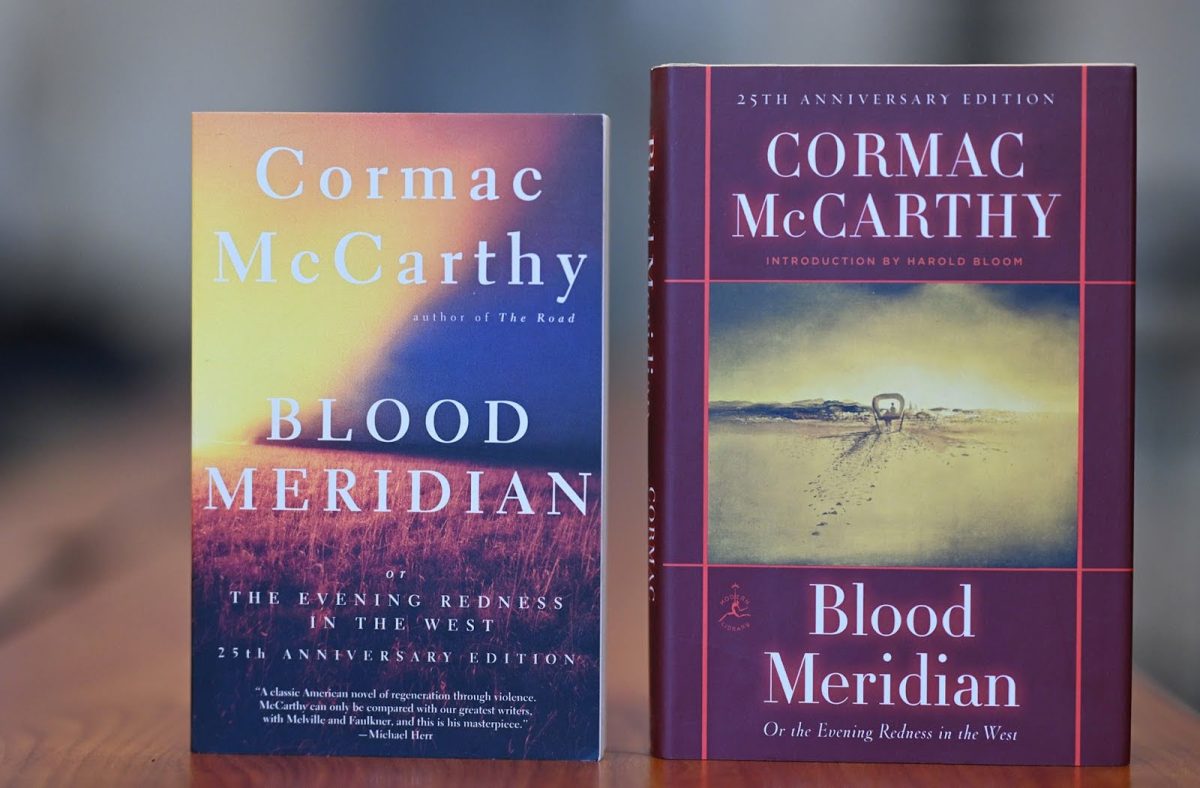
An interesting relationship between Blood Meridian and Bronx Science can be observed in the foreword to the 25th anniversary edition of the book. Harold Bloom (1930-2019 C.E.), who was a Sterling professor of humanities at Yale University and a Bronx Science graduate, Class of 1947, expounded upon the themes within Blood Meridian through a detailed and thoughtful analysis. Bloom lauds Blood Meridian for its Shakespearean prose and its striking characters, and provides ideas that are still relevant to the novel to this day. He compares Blood Meridian to other great written works of art, such as Herman Melville’s Moby-Dick and Shakespeare’s Othello.
The story follows a young man who McCarthy simply refers to as ‘the kid.’ After running away from his father and sister at the age of fourteen, he becomes a drifter, moving across old America and staying in dangerous locations. Arriving in Texas, he joins the military, followed by joining a gang of outlaws. Noticeably, McCarthy describes the kid as already having “a taste for mindless violence” in his earlier years, foreshadowing the kid’s future exploits.
It is important to note that McCarthy follows the concept of “show, not tell” to a tee in this novel. Throughout the book, the reader never hears the thoughts of any of the characters. Their personality and being are wholly derived through their actions and dialogue, making their exploits so important to understanding the story. This seems to be intentional on McCarthy’s part, as a majority of the book revolves around exploring the concept of free will and its consequences. It also compels the reader to be an active observer in the story, having to analyze the characters as the kid does.
The kid first comes across the Glanton Gang, a group of American scalphunters who murder Native Americans for payment, after being locked up in a jail in Chihuahua City with a friend of his called Toadvine. Prior to this, the kid had been a soldier under a man known as Captain White; White had the intention of entering the Mexican state of Sonora and civilizing the people within it, a sentiment common in America at the time. White and his company were massacred by a violent tribe of Comanches, leaving the kid as one of its only survivors. McCarthy introduces the Glanton Gang as “a pack of vicious-looking humans mounted on unshod Indian ponies riding half drunk through the streets, bearded, barbarous, clad in the skins of animals.” Toadvine lies to Glanton in order to get him and the kid into the gang and out of prison, and they become members of the infamous clique. Already the group is depicted as murderous and savage, making the kid’s joining of it a turning point in his life. He embraces violence by embracing a trade that exchanges life for money, thus making his relationship with hurting others even stronger.

The kid mainly interacts with a core cast of characters: Judge Holden, John Joel Glanton, Tobin, Toadvine, John Jackson, and a set of unnamed Native Americans known as the Delawares. The gang is significantly larger than what is depicted, as many side characters are mentioned offhandedly, usually during descriptions of fighting. At the beginning of the novel, the gang is contracted to murder and scalp members of the Apache tribe for money, specifically their leader known as Gomez. Glanton and his members take advantage of this deal, scalping the heads of any individual they see, Apache or not. Throughout the novel, they frequently massacre whole towns of people, murdering innocent men and women for money without any hesitation.
The kid is involved in these acts, yet McCarthy never includes his thoughts on the matter. Focus on the kid and his actions thin out towards the middle of the book, where the group is at its most violent. The kid is never described as taking part in the many massacres in the book, only being mentioned in shootouts and self-defense. However, it seems unlikely that the kid did not take part in the murder of innocent Mexicans and Native Americans, and this distinction is incredibly important to his character.
It should be noted that the way in which McCarthy writes causes a unique tone in the book in its totality. He is infamous for his lack of punctuation, his run-on sentences, and his vivid description of violence. In Blood Meridian, the reader can almost instantly pick up a feeling of desolation and bleakness as soon as the book is opened. The tone reflects both the deserted environment of the story and the lack of sympathy that the Glanton Gang feels for their murderous actions. All descriptions shown are very matter-of-fact, and the reader can imagine scenes in their head with grotesque detail.
The kid is shown to be different from the other members repeatedly in the novel. He does not mercy kill Tate as instructed by Glanton, a member of the gang shot through the hip, and rather tries to help him survive. Later in the novel, he attempts to rescue an apparently elderly lady from a canyon, only to find that she was already dead. He also does not fear the judge, arguably the most murderous and depraved member of the gang.
Judge Holden is described as a nearly seven-foot-tall individual devoid of any hair on his body and having extremely pale skin. He is demonstrated to be extremely intelligent multiple times in the book, having extensive knowledge of language, chemistry, and biology. His rifle is engraved with the words “Et In Arcadia Ego,” translating to “Even in Paradise, I am there.” Bloom interprets this as death being everywhere and the judge incarnating this concept in his gun, which ravages the deserts of Mexico. The other members of the Glanton Gang feel an intense unconformability around him due to his consistently relaxed nature and terrifying appearance. One member of the group stated that the judge created gunpowder from scratch, saving the gang from a tribe of Native Americans that had cornered them up a mountain.
The judge could be considered to be the perfect opposite to the kid, both physically and mentally. The judge goes out of his way to commit violence, dropping puppies in rivers and murdering children, while the kid is never shown to intentionally murder innocent civilians. The kid cannot read, yet the judge is shown to be eloquent in his speech. The kid is described to have large hands and close-set shoulders, while the judge has hands like a child’s and an imposing figure.
Throughout the book, the two characters are at odds frequently. After the judge, the kid, Tobin, Toadvine, and Brown escape the massacre of the gang at the hands of the Yuma tribe, the judge attempts to purchase Toadvine’s hat for a bucket of gold coins. Toadvine obliges, despite the hat being more useful to him in the scorching sun. This demonstrates the control the judge has over the gang members, using their greed and desire for pleasure against them. However, when the judge attempts to purchase the kid’s gun, the kid denies him. He refuses to give over an item that would be necessary for his survival for money that he may never get the chance to spend. The judge does not seem to hold the same power over the kid that he does over the others.
The ending of the book shows the kid growing into a man. No member of his gang remains with him, and he is left to drift the west alone. Toadvine and Brown are hanged for their crimes, and Tobin the ex-priest goes missing. The kid, now called the man by McCarthy, takes up odd jobs, protecting travelers as they traverse the west. He seems to distance himself from his past, once attempting to help an old Mexican lady out of a cavern. Despite this, the man still holds a remnant from his experience with the Glanton Gang, that being Brown’s necklace of ears. This may demonstrate how he is not fully free from his violent tendencies; later in the story, he kills a child not unlike himself, threatening him with a rifle.
The man’s attempts to escape his past eventually fail, and he comes across the judge for the last time in a bar. Strangely enough, the judge has not aged a day since the kid had last seen him. The judge speaks to him about life and death and ceremonies and destiny and a great dance in which he states that he participates in, all of it connecting in its totality. What the judge means by this monologue is largely up to interpretation by the reader, and it is difficult to summarize his words in a way that would retain their original meaning.
The judge’s true philosophy is realized in his monologue to the man. He believes that the true way of living life is to embrace one’s primal nature and inner violence and to use it to its fullest potential; only those that do this are truly “dancing.” Every member of the Glanton Gang accepted this philosophy, killing and scalping the innocent to turn a profit. The only exception to this was the kid, who never fully subscribed to the judge’s control and command and therefore did not “dance” with the judge. In this way the kid is both a good man and a hypocrite; he himself profited off of the destruction and death of others, yet his heart was more inclined to the value of human life. Bloom states that “To have known Judge Holden, to have seen him in full operation, and to tell him that he is nothing, is heroic.” The kid wins a small victory against the judge, and stands clearly across the line between himself and the epitome of evil.
The contrast between the kid and judge could not be more irreconcilable, and the book ends with the judge committing some kind of horrendous act towards the man in a bathroom outside the bar. McCarthy intentionally leaves out the fate of the man, only displaying reactions to it from those who witnessed it. One man is described as saying “Good God almighty” as soon as he sees what happened, and another warns him not to go in. With all of the violence previously depicted in the novel, one can only imagine what gruesome act would cause a character to react so strongly. The judge, it seems, has taken his vengeance upon the final member of the Glanton Gang.
The last scene in the book describes the judge dancing naked amongst revelers in the bar, playing the fiddle and grinning devilishly to onlookers. The most iconic lines of the novel are stated in this last portion of the story:
“He says that he will never die. He dances in light and in shadow and he is a great favorite. He never sleeps, the judge. He is dancing, dancing. He says that he will never die.”
Many years after its first publication in 1985, Blood Meridian is widely recognized as a literary masterpiece. TIME Magazine placed it in its top 100 English-language novels from 1923 to 2005, and historian and writer William Dalrymple has called it “the Great American Novel.” McCarthy’s unapologetic and unemotional writing style can be observed in many modern novels, and the concept of the pure-evil and idealistic antagonist of the judge is shown in many modern shows and books.
Unlike many of McCarthy’s other books, Blood Meridian has not been turned into a film adaptation despite being picked up by directors numerous times. Fans believe this to be because of its excessive violence and disturbing imagery, as well as McCarthy’s unique tone and style, which would be difficult to recreate on the big screen. Currently a Blood Meridian film is in production, directed by John Hillcoat and written by John Logan, though it remains to be seen whether the movie will pan out. McCarthy will be posthumously credited as an executive producer after his death in 2023.
“Only that man who has offered up himself entire to the blood of war, who has been to the floor of the pit and seen horror in the round and learned at last that it speaks to his inmost heart, only that man can dance,” says Judge Holden in Cormac McCarthy’s Blood Meridian.