
Swish, swish, swish!
It was the middle of the 19th century. In Asia, Japan opened up to the world for the first time since entering a period of isolation in 1603. In Europe, France experienced turmoil in the face of Napoleon III’s coup of the attempted Second Republic. But there was more. The times were changing, cultures were morphing, and art was evolving.
A fervor had swept over the West. Royalty and the bourgeoisie paced the floors of the extravagant Universal Exhibition. Impressionists twirled their paintbrushes. Vincent Van Gogh scratched his head. Women took out their sewing needles.
How do you capture its movement? Do you wear it? Paint it?
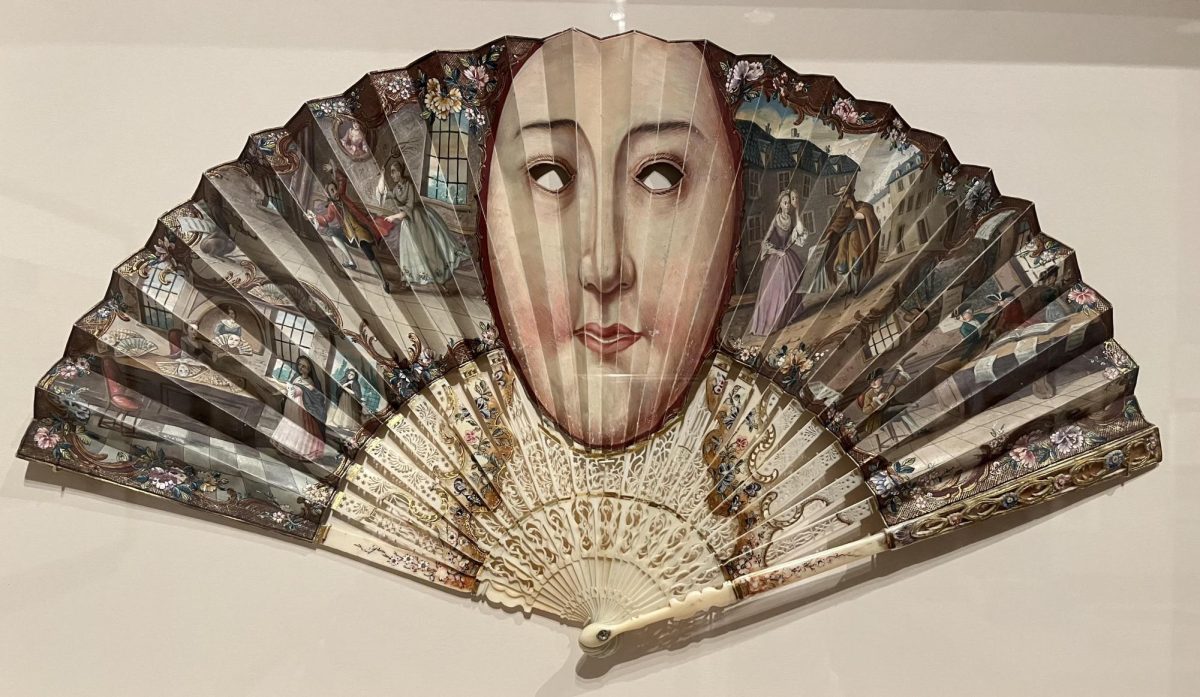
They call it a fan – this masterpiece that metamorphizes and swishes into a wind-summoning semi-circle, a semi-circle that contains provocative art. It is art that evokes an exotic echo of Japan or Spain.
Standing in the Fanmania exhibit at the Metropolitan Museum currently on view through Tuesday, May 12th, 2026, you can still feel the gush of air from two centuries ago. The layout of the exhibit highlights that the craze for fans is better organized into spheres – “Before 1800,” “Japonisme,” “Fans & The Feminine Subject,” “Souvenir & Advertising Fans,” “Fans of Spain,” “Fans in Motion,” and “Fans of the Opera.” Through each of these spheres and exhibit objects, co-curators Ashley E. Dunn and Jane R. Becker retell the 19th century through a new and surprising lens.
Cultural Representation, or Cultural Appropriation?
In 1603, Japan went into two hundred years of quarantine known as the Edo Period, hiding from what they viewed as a virus of Christianity and lack of control. There was no foreign trade, and citizens could not leave or return without an intricate inspection. This meant that art too was less publicized outside of Japan.
In The Mieidō Fan Shop, Japanese artist Utagawa Toyokuni I depicts a humble scene in a Kyoto fan shop. Boxes of leaves – the decorated fabric prior to being affixed on wooden sticks – are piled in the corner. Workers sit, intricately creating each fan piece by piece, and a male patron observes his shopping options. Fans had long been tokens of the wealthy, even so much that they were restricted to the upper class from the 9th to the 12th century.

Following the first Opium War in China, Japan felt the proximity of the growing West. They began to open their ports, causing the Tokugawa Shogunate to lose its tight grip on the people. When the Shogunate collapsed in 1867, the eyes from Europe and North America gravitated to this society bursting from East Asia to unpack the exoticness that had been sheltered for so long.
As the Meiji Period began in 1868, Japanese folding fan shops took on a whole new level of expertise and craftsmanship, aimed at attracting Western markets. As noted by Benjamin Rothstein in the Wittenberg University East Asian Studies Journal, “As local customer bases dried up, Japanese artisans increasingly had to adapt their art to suit the tastes of a West that was enamored with the idea of their country, but the idea did not always match the reality.” It worked: in a craze coined as Japonisme; millions of fans were shipped across the West. These fans, the flat uchiwa and the folding sensu, were sought after for their “Japanese” themes: blank space, poetry, motifs, and mediums like silk. Artists began to incorporate these intricate yet simple designs into their art, enjoying the challenge of the fan’s varied medium.
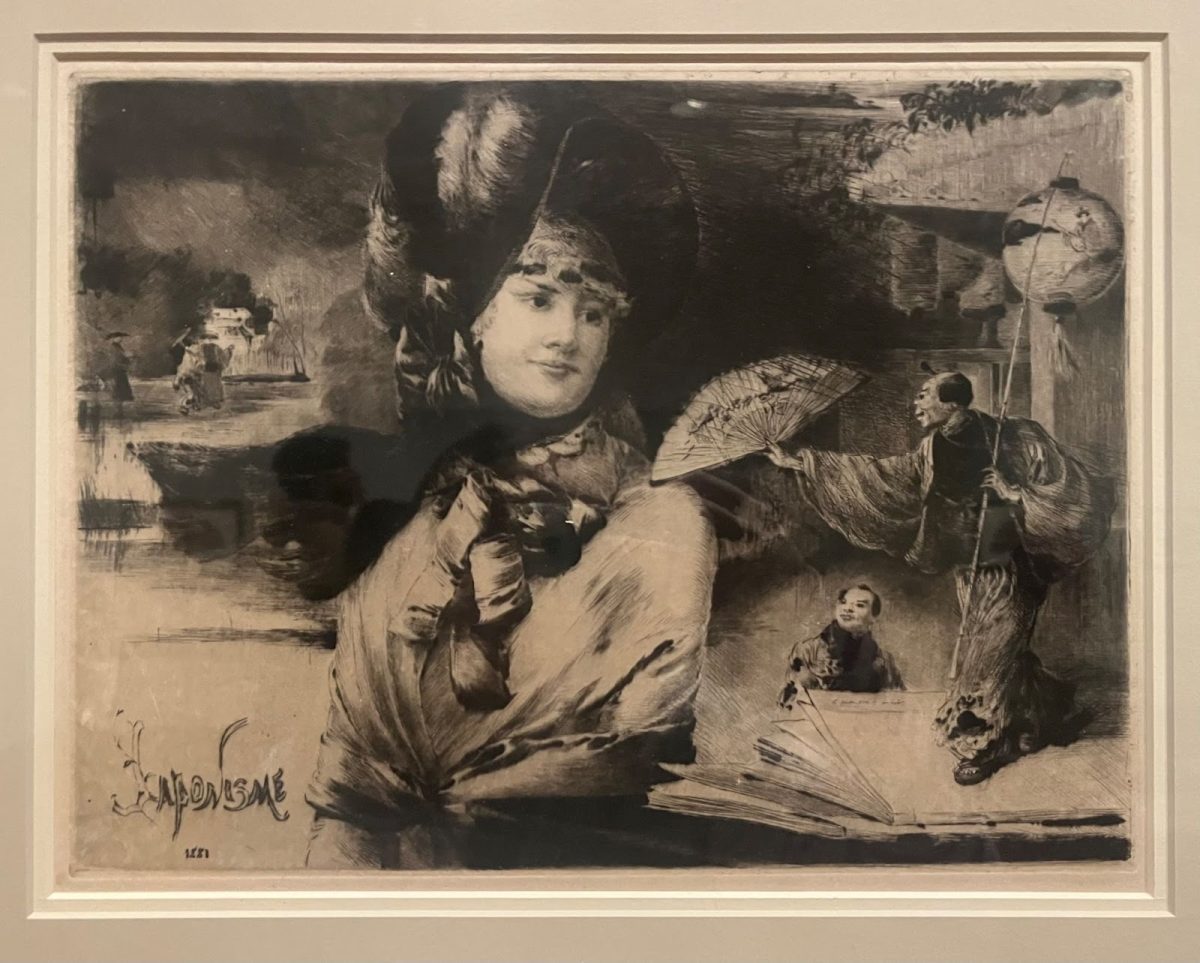
Most notable of these artists were Impressionists, who sparked a revolution in what art can capture. Unlike realistic painting capturing locations or people, Impressionists questioned what had long been preferred. If the world of artists was a game, they changed the rules. Japanese fans matched this newfound attraction to breaking the norm. Edgar Degas was one of the most prominent Impressionists and was heavily influenced by Japanese art. Degas once said, “One sees what one wants to see. It is false, and that falsity is the foundation of art.” The core of Impressionism was provocative creativity, and what better way to “see what one wants to see” than Japanese motifs and styles like empty space.
In the 1879 Fan Mount: The Ballet, Edgar Degas depicts ballet dancers in gold metallic-paint tutus dancing in a watercolor abyss off a silk fan. So as these young ladies jump, they too jump into deep darkness, surrounded by heavy metallic clouds. As a viewer, you see the work in layers – the night, the shimmer, the dancers. Like a song so soft you must pause until you hear it, enough to recognize the little harmonies seeming to coalesce into the curves of the room. The doubt that the song exists at all, this is how Degas used the Japanese style of blank space to create a piece of sad beauty.
Just like Japanese themes, Japanese people were appropriated as shown in La Rêve. A poster advertising León Gastinel’s ballet set in 16th century Japan, stereotypes of the culture are highly prevalent. All the dancers wear kimonos and hold fans. The backdrop is covered corner-to-corner with a fan depicting two Japanese men. The attraction to Japanese culture extended past Impressionists into separate art forms like dance.
Chinese fan-making grew as well, and most customers in the West had no idea that the products they bought were not Japanese, but the mainland neighbor. This begs the question of what aspect of Japanese culture captivated consumers, and whether it was actually unique to Japan.
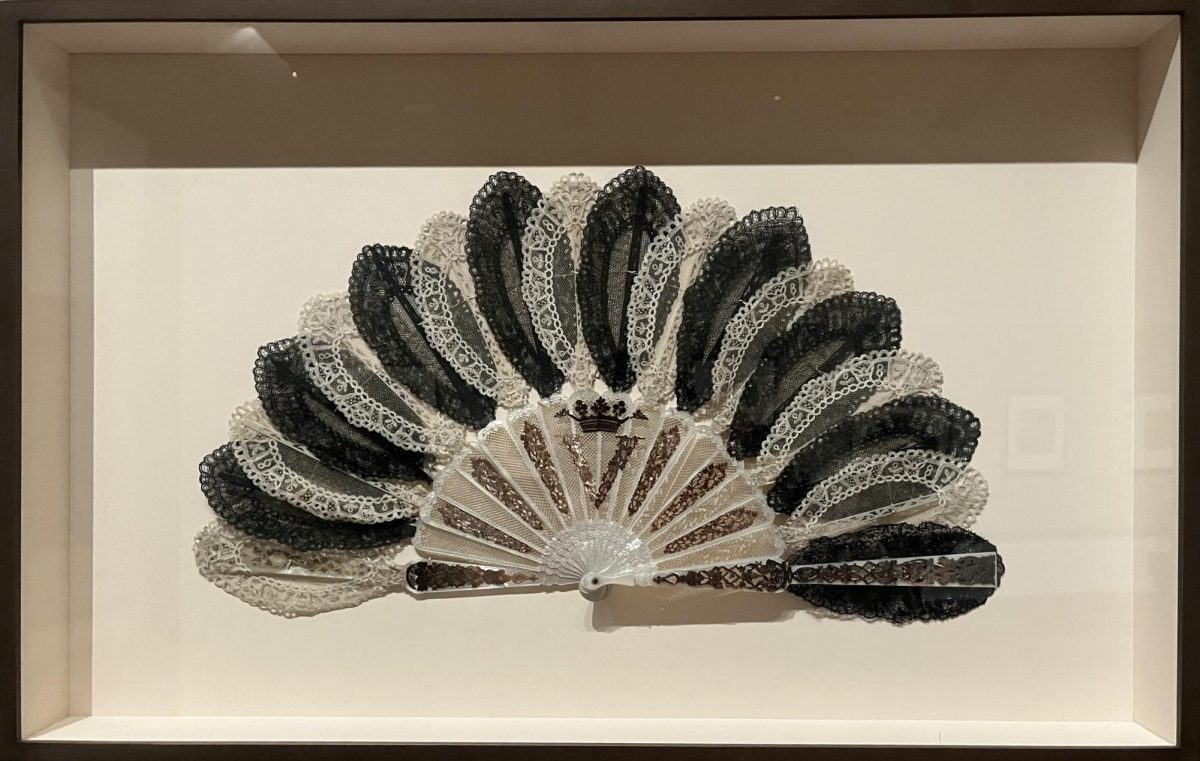
Akin to Japonisme, a closer-to-home Hispagnolisme evoked the creation of Spanish-styled fans. With the jerk of a wrist, the large fans open to tell memories of women with large ruffly skirts who whirl and click their heels on the floor to the intense strumming of a guitar – Flamenco. This exotic culture became relevant when the reigning Napoleon III married Eugénie de Montijo, a Spanish woman who quickly set trends that rippled through the Western world. People from all levels of society became allured by her bold fashion standard, an obsession that spiraled out into a broader love of this fictionalized story of Spanish culture, of “exotic difference: bullfighters, red roses worn behind the ear and dancing girls.”
A Woman’s Most Reliable Companion
Loneliness is hard to explain. It is a sadness of absence, reminder of rejection, and common for women in this time period. In a series of personal correspondence, Charlotte Brontë wrote, “The trouble is not that I am single and likely to stay single, but that I am lonely and likely to stay lonely.” At the time, she spoke for millions of middle-class women. Due to industrialization, men began to find jobs out of the home, and women were expected to stay home and take care of the “haven in a heartless world.” With more restrictive dresses and servants, women were also expected to learn skills. As Jane Austen wrote in Pride & Prejudice, “A woman must have a thorough knowledge of music, singing, drawing, dancing, and the modern languages…besides all this, she must possess a certain something in her air.” Preceding the main boom of fans, Austen foreshadowed an expectation for women that was continuing to grow. During the 19th century, an abundance of ‘women advice manuals’ emerged, teaching women how to prosper in their separate sphere.
A popular format for advance? Look to one of the exhibit fans: The Ladies Bill of Fare, or A Copious Collection of Beaux, in which in the center is a poem of womanly advice:
“To plague and please all womankind
Here’s Gallants sure a plenty!
Chuse then a Bueau to suit your mind,
Or change ‘till one content ye.”
Made in 1795, the fringes of the fan have drawings of different male caricatures: The Merry Lover, Melancholy, Impetuous, Cautious, Platonic, Carnal Lover, Constant, Capricious, Coquet, Lover of the Cash, Lover of Himself, and Lover of Nobody. Like a historical version of Women’s Health Magazine, this convinces women that men appear in stereotyped forms that they can change until it “content ye.”
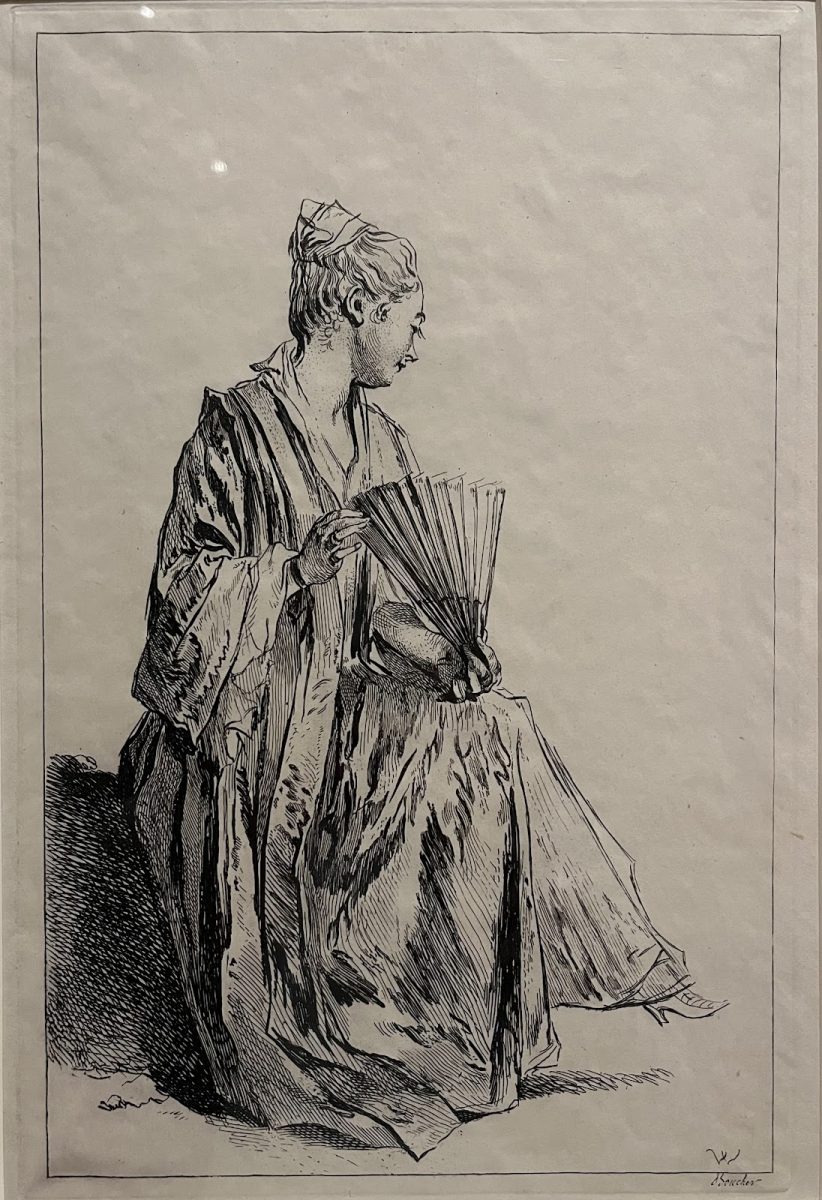
Making fans offered women a “lady-like” hobby. In the early 19th century, there was a surge of “nostalgic looks,” and the fans displayed lyrics and words, stories and symbols. In the 1840s to 1870s, simplicity and deep beauty took to the streets. Large crinoline dresses, romantic lithographic prints depicting 18th and 17th century scenes. Nearing the turn of the century, fashion was slimmer yet more intricate – drapes, beads, and fans made with gown fabrics to match.
Women also used fans as an object of romantic symbolism. Say, a Victorian woman fluttered a fan on the right side of her face – she thus implied, “Follow me.” Then if she stopped, and rested it on her left ear – she now meant, “I wish to get rid of you.”
This era was met with the introduction of the “rest cure,” a medical attempt to “cure” female depression. A traumatic treatment of forced bed-rest and electrotherapy was soon realized not to be the answer. What took time to understand was that many women were profoundly downcast from their social confinements, even if they had what appeared to be a good life.
The lonesome hours were when the husband was at work. Yet even worse than that, was when they were home, because the truth was clear – “I am lonely and likely to stay lonely.” Perhaps the only distraction was to make, use, and want yet another fan.
Portable and Memorable
Every step of the fan-making process required an artistic decision, adding up to a distinct creation.
In the 21st century, souvenirs are thrust upon tourists in every possible way – gas stations, shops, and more. They are affordable memorabilia for the magnet-lacking fridge and friends back home who could not make the trip. During the 19th century, railroads became more extensive and accessible, leading to the growing middle-class to take to the train tracks as tourists. Fans served as some of the first souvenirs these people were greeted with when they arrived at their new destination.

Businesses jumped on the opportunity to increase their profit, and used the fan as a way to discretely advertise. In Chemin de Fer de l’Ouest, Sur La Plage, artist Théophile-Alexandre Steinlen promotes the Chemic de Fer de l’Ouest railroad company’s excursion rates to a seaside. The very concept of a fan became a symbol to place onto advertisements as well. Virginia company Allen & Ginter Cigarettes, for example, made promotional trade cards of women wearing trending dresses and fans in different positions. As the exhibit caption states, “Since the fans depicted were associated with European fashions, these advertisements may well have been geared to society women who began smoking to mimic the worldliness of continental women.”
For activists, the fans told a widespread political story. The 1795 print, Fan Design With Republican Assignats, displayed the banknotes given by the first French Republican government. The meaning of them shifted, from a symbol of Republican loyalty to worthless papers better off used for something more functional than profit – a fan.
The Secret Code
Co-Curator Ashley E. Dunn, who is the Associate Curator in the Department of Drawings and Prints, poetically noted, “fans are familiar objects to everyone.” It is in the comfort of their commonality that fans have long served as a vessel of expression.
Fans contain symbols. Simultaneously, they were used to reflect class – in the Edo period of Japan for instance, fans were only for high-status people. By the mid-19th century in Europe, however, they became more accessible for the expanding middle-class that was attracted to the foreign art of fans. Across the Atlantic in the U.S., they reflected a middle and upper-class that aspired to be more European, as fans soon grew to be associated with European culture.
Studying the cultural exchange between fans serves as an exemplification of how the 19th century was the beginning of an irreversible era of modern globalization. Art was adjusted to attract a culturally-specific market, and in its popularity it morphed and evolved into forms beyond the original. If someone who had no knowledge of the past were to see only the objects in the Fanmania exhibit, without the caption, perhaps they would have a causality dilemma. What came first? The art style or the fan? Edgar Degas or the fan? The advertisement or the fan?
Little would they know of the true story: An unsuspecting object that originated as a functional way to cool off, that evolved due to a series of global shifts and a boom of consumerism, creating a ripple effect that perseveres today.
They call it a fan – this masterpiece that metamorphizes and swishes into a wind-summoning semi-circle.