
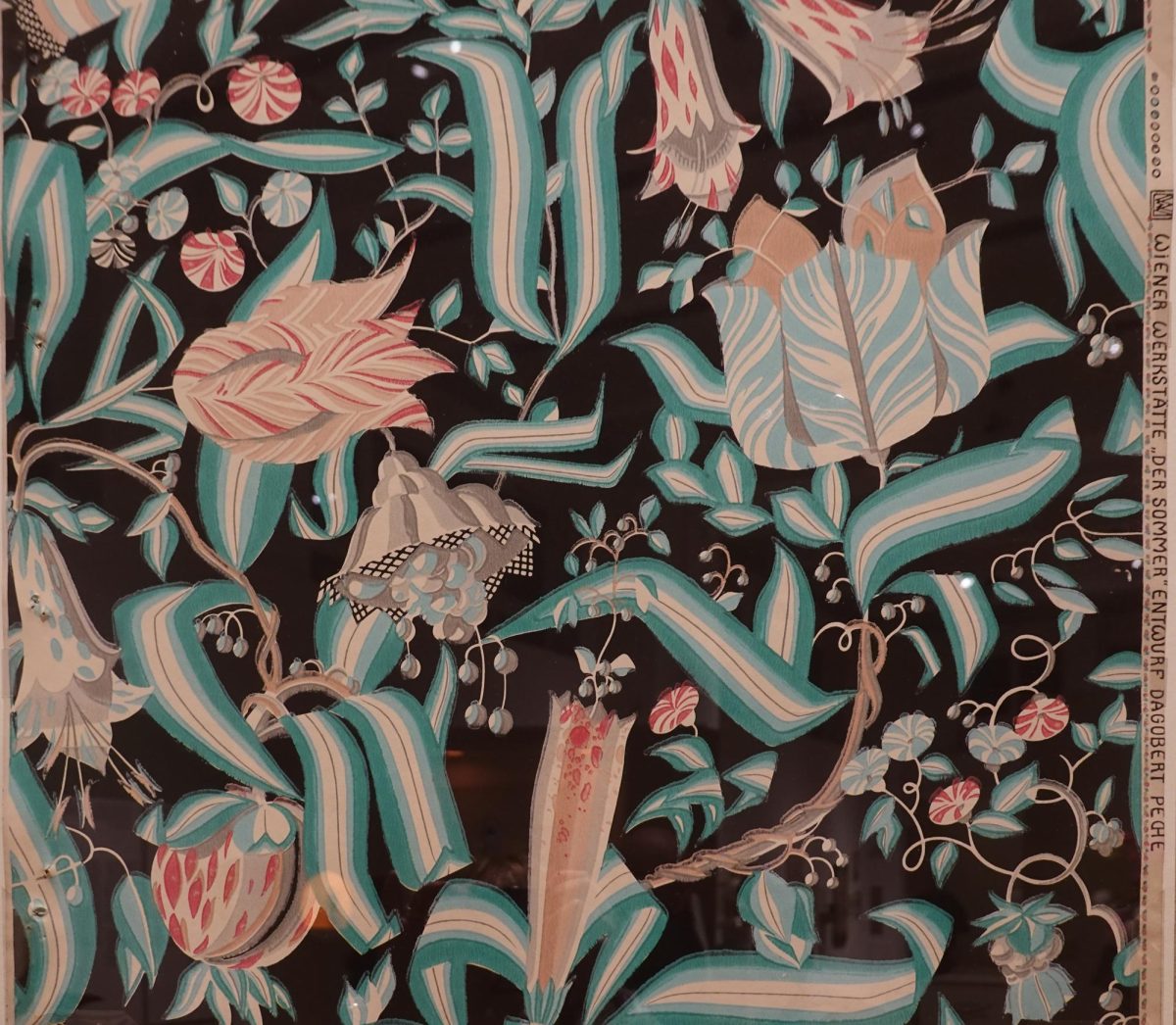
On the side of the room, two big cylinders with intricate designs carved on them were displayed in a glass case. One was filled with birds and flowers, an explosion of design including absolutely everything. Its neighbor had a simpler design. Large lines swooped across it, meeting together to form neat rows of rhombi fitting perfectly into each other. At the center of each rhombus, there was something that from a distance looked like a palm tree, but up close, I realized that it resembled some other type of plant. Both were intricate, strange, and gorgeous. After I read the description underneath the display, it was revealed that the engraved cylinders were used for making wallpaper by a common 20th-century technique known as roller printing, in which the cylinders are rolled onto papers to transfer dye or ink. Both of these roller printers were designed by Dagobert Peche and are currently under display at the Neue Galerie as part of the exhibit Dagobert Peche: Ornamental Genius, which is currently on view until Monday, May 4th, 2026.
Dagobert Peche was born in 1887 in St. Michael im Lungau, Austria. He grew up in the vibrant city of Salzburg, and following that, went to Vienna for studies in 1906. Peche had the desire to be a painter; however, he instead followed his father’s wishes, studying architecture. In 1911 Peche graduated from the Academy of Fine Arts in Vienna.
In 1915, after the world had become shaken by the anticipated event of World War I, Peche started working for the Wiener Werkstätte. The Wiener Werkstätte was a movement founded in 1903 when it branched off from the larger organization known as the Vienna Secession, which was founded in 1897. The movement was led by Joseph Hoffmann and inspired by John Ruskin and William Morris, founders of the Arts and Crafts movement — an English movement that started in the 1860s. These trailblazers influenced and redefined architecture, laying the groundwork for Peche’s studies.

When you first walk into the small exhibition room on the second floor of the Neue Galerie, you are confronted with works scattered across walls, some of them by Dagobert Peche, others by Joseph Hoffman.
“Our aim is to create an island of tranquility in our own country which, amid the joyful hum of arts and crafts, would be welcome to anyone who professes faith in Ruskin and Morris.” – Joseph Hoffmann, 1903.
As Hoffmann explains in the quote above, when the Wiener Werkstätte was founded, its goal was to bring a “tranquility” amongst the ever-looming shadow of a global turmoil that was on the verge of emerging.
At the Neue Galerie, there are countless pieces of art surrounding the perimeter of the room. Aside from furniture and posters, there are two vitrines — big glass cases for displaying artwork — in the center of the room. Prior to visiting the exhibit, I had looked it over online. Out of the photos that the Neue Galerie had posted on their webpage, most of Peche’s work featured expensive materials, like silver and brass, giving an impression of monochromatic elegance. One of the vitrines immediately struck me as Peche’s work. I recognized the silver items as they blended in with the rest of the room.
However, the one next to it displayed works that I would have never thought to be Peche’s, based on what the Neue Galley had advertised on their webpage. The works were colorful, ceramic, and even works that looked like extreme origami, made only out of paper. This case displayed earlier works of Peche, mostly from before the 1920s, and I was left surprised, as I saw the reflection of crafts my third-grade self would make in his construction of a tiny town made out of paper. Peche’s ability to build an entire city out of paper reminded me of the projects I had to do when I was younger, such as dioramas that I made when I was asked by my teacher to construct my neighborhood out of cardboard. This is not to say that Peche’s artwork is as flimsy as that of an elementary school kid; it is to say that there is an underlying expertise in capturing the nature of innocence: of redesigning the world so it fits in a shoebox, of not being able to tie shoes while still having the ability to turn everything into art.
Of Peche’s later works made in the 1920s, the Neue Galerie displays Peche’s use of more expensive materials, such as a teapot made out of silver, ivory, and turquoise, which is on display. This is an unusual curatorial choice, since upon entering the gallery, there is a paragraph of wall text stating that Peche used modest materials, like paper, in post-World War I Vienna. The glass case that features Peche’s “postwar” works contains his most expensive creations, despite the fact that Peche faced poverty and started using less expensive items. The execution of this exhibit does not showcase the humble Peche, as it only features three of his paper works in comparison to his countless metal works, one of them being the paper town and the other two being Christmas ornaments, all three dated 1920 or prior. The humble Peche is not a myth; in addition to poverty, Peche also understood the pain of illness, as cancer would cut his life short in 1923. Peche is almost never brought up without the mention of what he could have become had he been given the opportunity to live longer. Through their display of mostly expensive items, the Neue Galerie implies that there is more worth in spotlighting luxury works, as the general public finds them more popular and impressive. For example, Peche’s brass chandelier is widely well known; however, his paper Christmas ornament, The Four Ladies, is so unknown that it cannot be found on the internet. Despite the lack of popularity, I find Peche’s cheap, inexpensive paper works kinder, softer; they hold a promise that there is life after war.
In 1917, Peche moved to Zurich, Switzerland, to become the director of the Zurich branch of the Wiener Werkstätte. He lived there until 1919, when he returned to Vienna. In the aftermath of the tragic First World War, Austria was left in poverty. Peche fell victim to the terrible housing crisis of Vienna — even the ornamental genius himself was facing poor living conditions. Ironically, while Peche was designing items for homes of luxury, he was living in a home that was far from it. And still, Peche saw purpose in creating his art.
Dagobert Peche crafted his famous bird-shaped box in 1920, during the housing shortage. While struggling for a roof over his head, Peche was designing silver and coral birds for wealthy homeowners. Who needs a bird-shaped box? One could argue that when it came to the bird-shaped box, Peche’s purpose in creating it was because of its practicality: boxes have a function. However, there were things people needed more. While the wealthy indulged in the pleasure of having decorative items, there was a constant awareness in Vienna that thousands did not have appropriate living conditions, much less silver boxes. There is no other way to phrase it: Peche was thrust into the grim conditions of Vienna, and there he stayed. Nevertheless, Peche still thought art was worth making, and not because he thought that what he fabricated had a level of practicality. Ornamental items, by definition, are something of luxury — a price the general public cannot afford, a price that Peche himself could not afford. There is no reason behind his creations except that Peche created for the sake of creating.
When I looked at photos of the bird-shaped box online, I kept thinking to myself, “Who would want a metal bird in their house?” It did not seem particularly practical. But when I saw the item face-to-face, I could almost feel the bird’s coral eye peering at me through its peripheral vision. I was left impressed by the level of detail and the way the legs of the bird were so thin, as if they could not support the entire structure. My thinking shifted: “Who could make metal feel so real?” Still, I could not understand who would want it in their house, especially given the uneasy feeling it evoked in me, as if it knew something I did not. However, this aesthetic works for 20th-century Austria, where the style of the Wiener Werkstätte dominated. Objects from back then would be unsuitable for the modern house design, which is part of the thrill of Peche’s work. It allows you to travel back in time.

Today, I look back at Peche and remain mystified. The items he created are beautiful, impressive, and detailed, but I cannot begin to grasp their purpose in the same way that I cannot begin fully to grasp the scale of destruction of the first modern war. The first World War was a sudden shock of mass destructive technology; the heavy grief filled the air and stayed there. The pain and poverty that emerged from it are inconceivable to the modern American. But Peche lived it, and as a result, the full exhibit poses the question: Why would anyone want to manufacture a luxury item they cannot afford themselves? And that encapsulates Dagobert Peche’s greatest work.
The strongest impact that Peche leaves behind is his demonstration of the rare human phenomenon of creating beauty amidst destruction. Peche’s nature of continuing to make art, even through tragedy, is an argument in itself that art is a necessity, not for its practicality, but for its presence.
There is no reason behind his creations except that Peche created for the sake of creating.