

On Fifth Avenue between East 88th and East 89th Streets, standing out amongst the quiet buildings of the Upper East Side of New York City, lies the Guggenheim Museum, designed by Frank Lloyd Wright. Currently on display in the three Tower galleries of the Guggenheim is the exhibit Gabriele Münter: Contours of the World, on view through Sunday, April 26th, 2026. The exhibit features over fifty paintings and nineteen photographs by the groundbreaking expressionist artist, Gabriele Münter (1877-1962).
Gabriele Münter was born in Berlin, Germany, in 1877, to an upper-middle class German family. Having lost both parents at the age of 20, she and her sister, Emmy, with her family’s inheritance, went on a two year trip to the United States. First landing at New York, the two sisters traveled through Texas, Arkansas, and Missouri in order to visit relatives and to take photographs of their journeys. In 1802, after returning to Europe, Münter sought to advance her artistic career with further training at the Phalanx School, an art school in Munich. Here, she worked under famous abstract artist Wassily Kandinsky, learning new techniques of sculpting and woodcutting. She was introduced to impressionism, which focused on the visual aesthetics of art, emphasizing detail and light, and Expressionism, which was centered around the emotion that the paintings evoked within the viewers. Kandinsky immediately recognized Münter’s natural talent, and through a shared love for painting, they formed a personal relationship – one that later became romantic. Eventually, her medium shifted from film to canvas paintings, and began to paint the views she saw through her travels. Even as she shifted her focus to painting, she continued to photograph her surroundings. Both her paintings and photographs focused heavily on contrast within each shape and color she used. Kadinsky and Münter traveled throughout Europe for six years, capturing each place they visited through oil paintings. In 1911, the two founded the ‘Der Blaue Reiter,’ which translates as the ‘Blue Rider’ Group, an organization of Expressionist artists that focused on the use of symbolism and abstract art. Then, in 1914, Kandinsky returned to Russia, and married another woman. Münter stayed in Western Europe, traveling through Scandinavia, and continued to paint before spending her later years in Germany.
Walking into The Guggenheim’s Gabriele Münter: Contours of the World exhibit, viewers are immediately met with Münter’s earliest oil paintings where vivid brushstrokes intertwine to convey the essence of ordinary landscapes. Here, Münter portrays varying light and color schemes through scenes of rolling hills, houses, and the vast surrounding sky. The thick, black outlines create a deep distinction between each color, allowing them to leap off the canvas.
In Münter’s Sunset over Staffellsee, a sea of blue and pink surrounds a black silhouette of a city while the sun sinks behind the clouds, leaving the last traces of daylight glowing above the hills. Here, she conveys a fleeting sense of time where even the shades and colors of the water, sky, and hills are ever-changing. Another painting, Town in Snow, depicts a town street, with houses swallowed by jackets of snow, each one casting shades of blue and pink onto the snow-covered ground. A blur of a person walks alone through the middle of the ice covered pathway, illuminated by a soft glow of sunlight. This painting captures the early morning light brushing over the buildings of a crowded street — a small yet unmistakable sense of energy peeking through the dreary winter scene.
Through these artworks, Münter’s profound fascination with the world is apparent, as she captures countless landscapes and rivers, each bright, contrasting color not only showing its beauty, but seemingly giving it a distinct personality.
Münter’s paintings of human life show a different angle of her talent. The sharp outlines and color palettes of her portraits echo those of her early landscape paintings. Contrasting strokes of color are patched meticulously together to convey the personality of each character, overruling minuscule physical details. In her paintings of the interiors of houses, Münter focuses on the small details in the lighting of rooms through precise brushstrokes while still utilizing the same breathtaking hues of her famous landscape paintings. Still Life With Mirror depicts a painted mirror with shades of teal and green overlaid so the light appears to be dancing around it, where no two inches are the same color. Another mirror is reflected in it, oblong and lined with a twisting frame of brass. It is tilted, revealing a different angle of the room, with small shapes visible, yet blurred enough so that the contents of the room remain unknown. In another painting, Dark Still Life, the light radiating from her previous landscapes paintings is condensed into a few human figures engulfed by darkness. Similar to a majority of her works, her subjects take a blurred form, but this painting evokes a sense of sheer uncertainty and near discomfort.
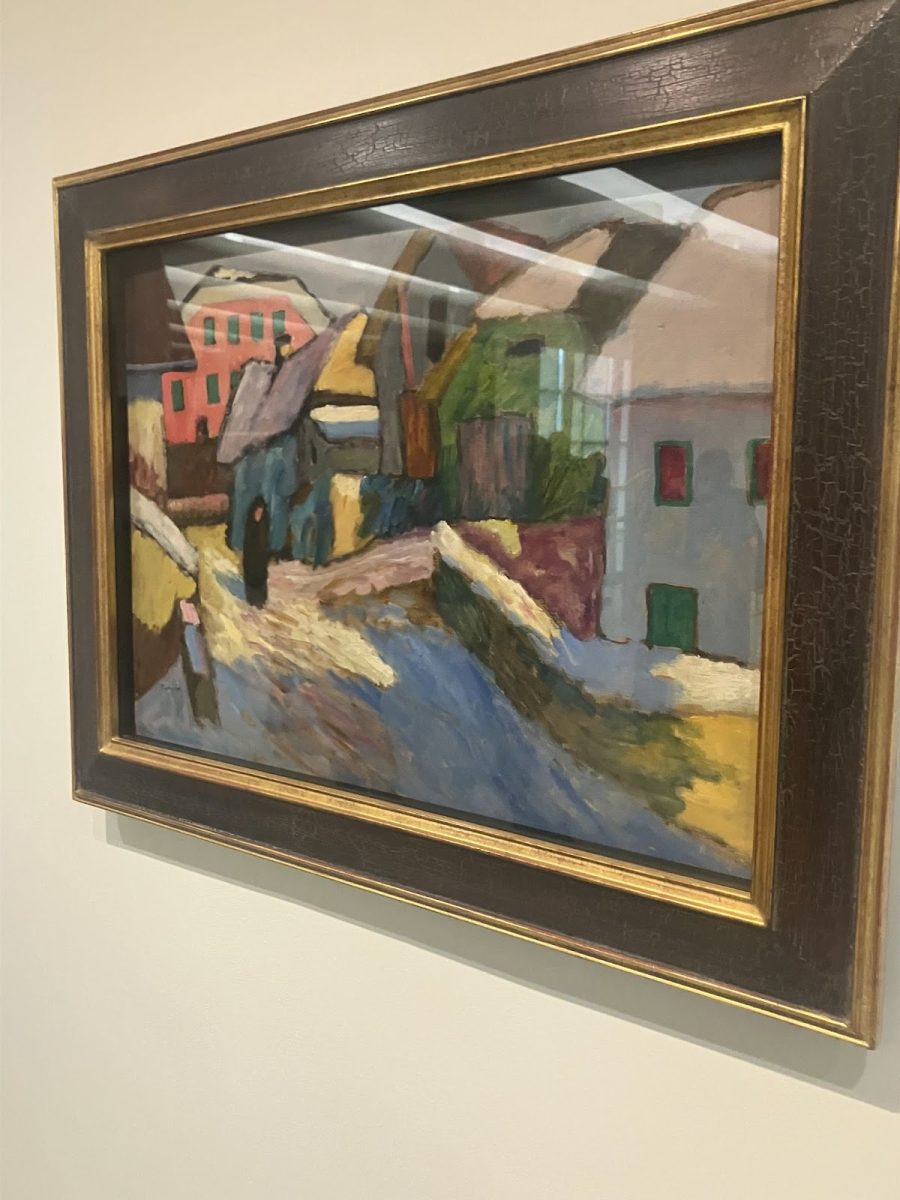
Münter’s first works of photography, completed over a decade before the paintings on display in the rooms at the start of the exhibit, are secluded in the last room of the first floor of the gallery, where black and white photographs provide a stark contrast to the vibrant colors of the previous paintings in the opening galleries.
Over the course of her travels to the United States, Münter reflected on her journey, documenting what daily life was like through her collection of nearly 100 photographs. She captured scenes of everyday life throughout the country, with a diverse collection of photographs, ranging from bustling streets in Western cities to quiet houses surrounded by miles of empty farmland. Many of these photographs, through their subject matter and composition, served as a blueprint for Münter’s later expressionist paintings seen in the previous rooms. She focused heavily on asymmetry, highlighting the candid and unscripted nature of her subjects, authentically bringing them to life. Unlike the practice of many artists of the time, Münter photographed people of color and women among her subhects, capturing an accurate image of the world around her, one with a wide range of people represented.
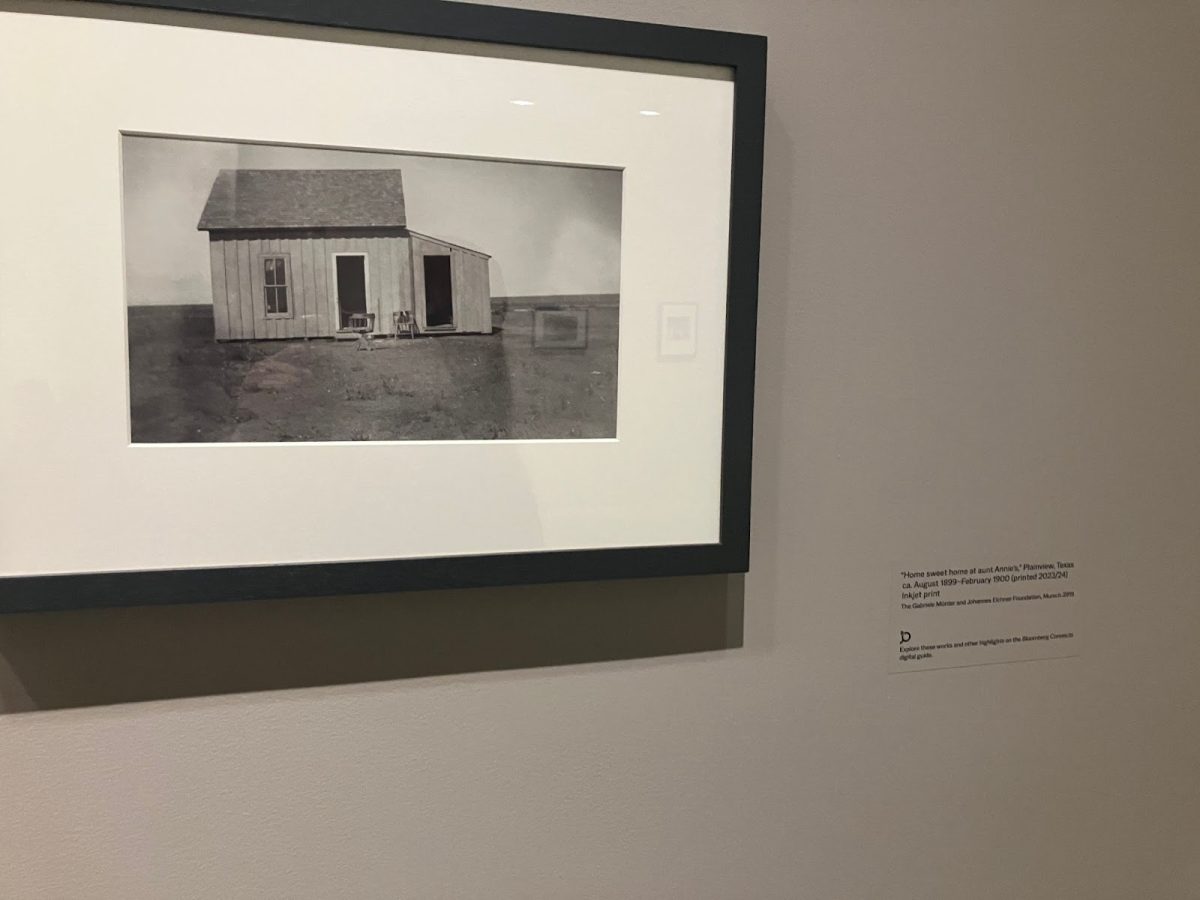
Gabriele Münter lived directly after the Impressionist movement of the mid-late 19th century – where artists focused on conveying the beauty of nature and everyday life through aesthetically appealing, realistic paintings. She was more intrigued by Post-Impressionism, focusing on how her work was captured by light. However, she had the same objective as Impressionist artists. Münter wished to capture the beauty of the world around her in society and nature, and she did so in an Expressionist manner, capturing underlying emotions in each of her painted works.
Münter’s later works, displayed in the room behind her photographs, take the form of cold, winter landscapes, with small houses and evergreen trees drenched in snow, along with faded mountains in the background. Instead of vivid colors, in these paintings, Münter uses a more muted color palate in order to capture elements of her landscapes as they peer through velvety layers of snow. Many of these paintings connote a feeling of solitude, the quiet side of the world, where winter has fallen over the bold landscapes that she previously painted. However, in this solitude can be found a quiet comfort. In Breakfast of the Birds, a woman sits at a round table filled with tea and bread, looking at the snowy view outside her window. Red, pillowy curtains are pushed aside, and small birds rest cushioned against the snow of a bare tree. It is here, through her paintings of desolate snowscapes, where Münter’s ability to show the beauty that can emerge from even the bleakest scenes of nature is most evident.
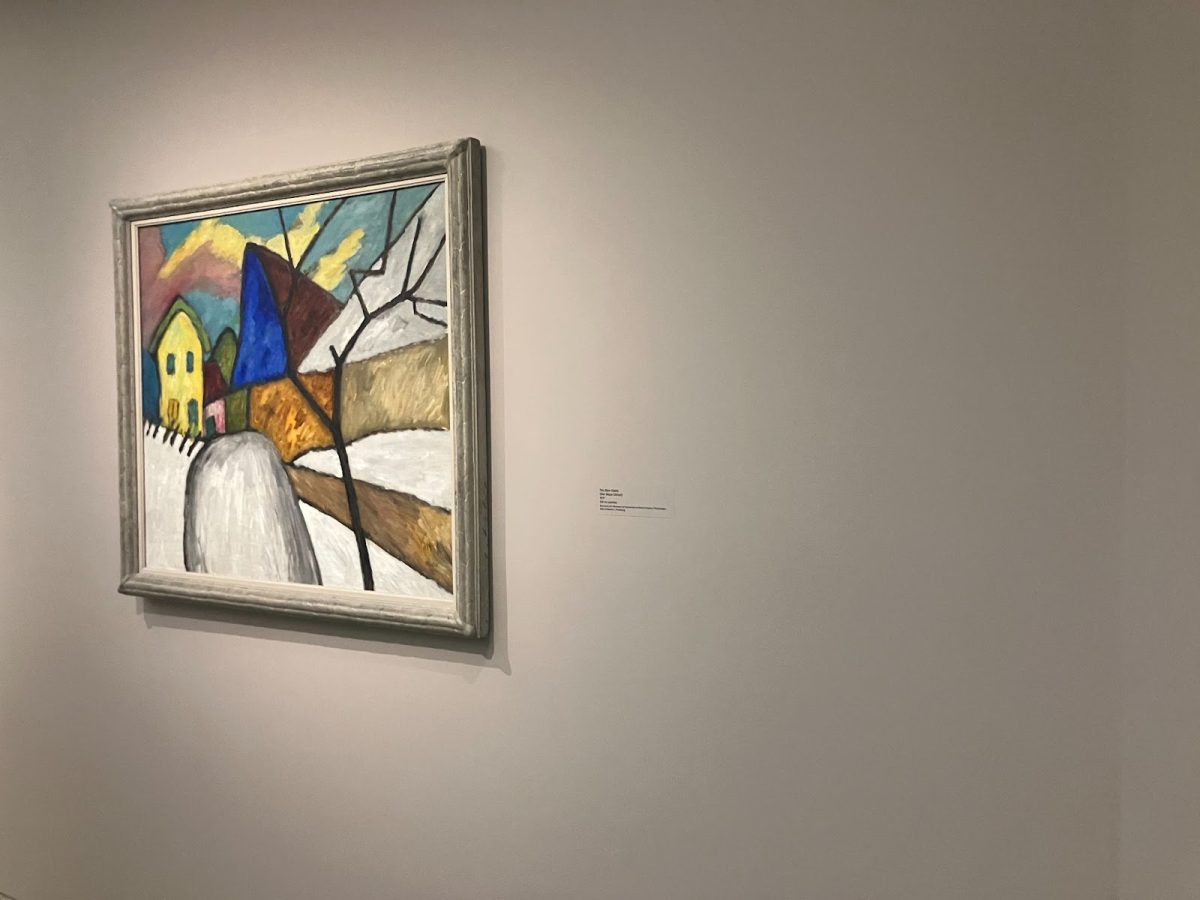
Megan Fontanella, Curator of Modern Art and Provenance at the Guggenheim, curated the paintings on display in this exhibit. The photography selection was curated by Fontanella along with Victoria Horrocks, Curatorial Fellow of Photography at the Guggenheim. Together, their curation is meticulous. Gabriele Münter: Contours of the World highlights Gabriele Münter’s versatility in her paintings and photographs, illustrating Münter’s ability to capture the essence of her surroundings, which evoke strong emotions in the viewer. While the subject matter in each painting and photograph varies, Gabriele Münter’s love for the world shines through in each piece on display.
Walking into The Guggenheim’s Gabriele Münter: Contours of the World exhibit, viewers are immediately met with Münter’s earliest oil paintings where vivid brushstrokes intertwine to convey the essence of ordinary landscapes. Here, Münter portrays varying light and color schemes through scenes of rolling hills, houses, and the vast surrounding sky. The thick, black outlines create a deep distinction between each color, allowing them to leap off the canvas.