

Five enormous paintings tower over visitors, each inch of one’s gaze taken by the profound abstract landscapes that characterize Helen Frankenthaler’s oeuvre. Despite spanning only five paintings and a singular room at the Museum of Modern Art (MoMA), the Helen Frankenthaler: A Grand Sweep exhibit remarkably captures the extensive range of styles that blossomed from Frankenthaler’s bold, free-spirited artistic ethos. Initially opening on Tuesday, November 18th, 2025, and on view through Sunday, February 8th, 2026, the exhibit welcomes visitors to experience Frankenthaler’s distinctive vision of abstraction, showcasing “the work of one wrist” that shifted the trajectory of the Abstract Expressionist movement.
Growing up coinciding with the beginnings of Abstract Expressionism in midcentury New York, Frankenthaler emerged within a movement dominated by figures like Jackson Pollock and Franz Kline, whose aggressive brushwork and masculine mythologies of paint and gesture defined the era. However, Frankenthaler found herself drawn to an increasingly delicate form of abstraction. Her early breakthrough came through the soak-stain technique that she invented: pouring thinned oil paint directly onto raw, unprimed canvas and allowing it to seep, bleed, and settle organically. Using a technique seemingly reliant on randomness, there was inherently potential for chaos, but Frankenthaler’s faith in her work never wavered. “I knew how the lines would dance in. I felt sure of myself,” Frankenthaler said, assured that gravity, absorption, and chance were collaborators in bringing her artistic vision to fruition.
Mary Beth, an exhibit visitor with whom I spoke, remarked that Frankenthaler’s pouring process creates “intriguing, almost jarring edges that can only come from accident—and it’s beautiful.” In Frankenthaler’s Toward Dark (1988), the edges are certainly striking. Muted gray and beige washes slide into the dark central form, their edges feathering as the paint thins across the canvas. Along these regions, the color bleeds unevenly, forming cloudy borders and translucent overlaps that reveal the randomness of the pour.
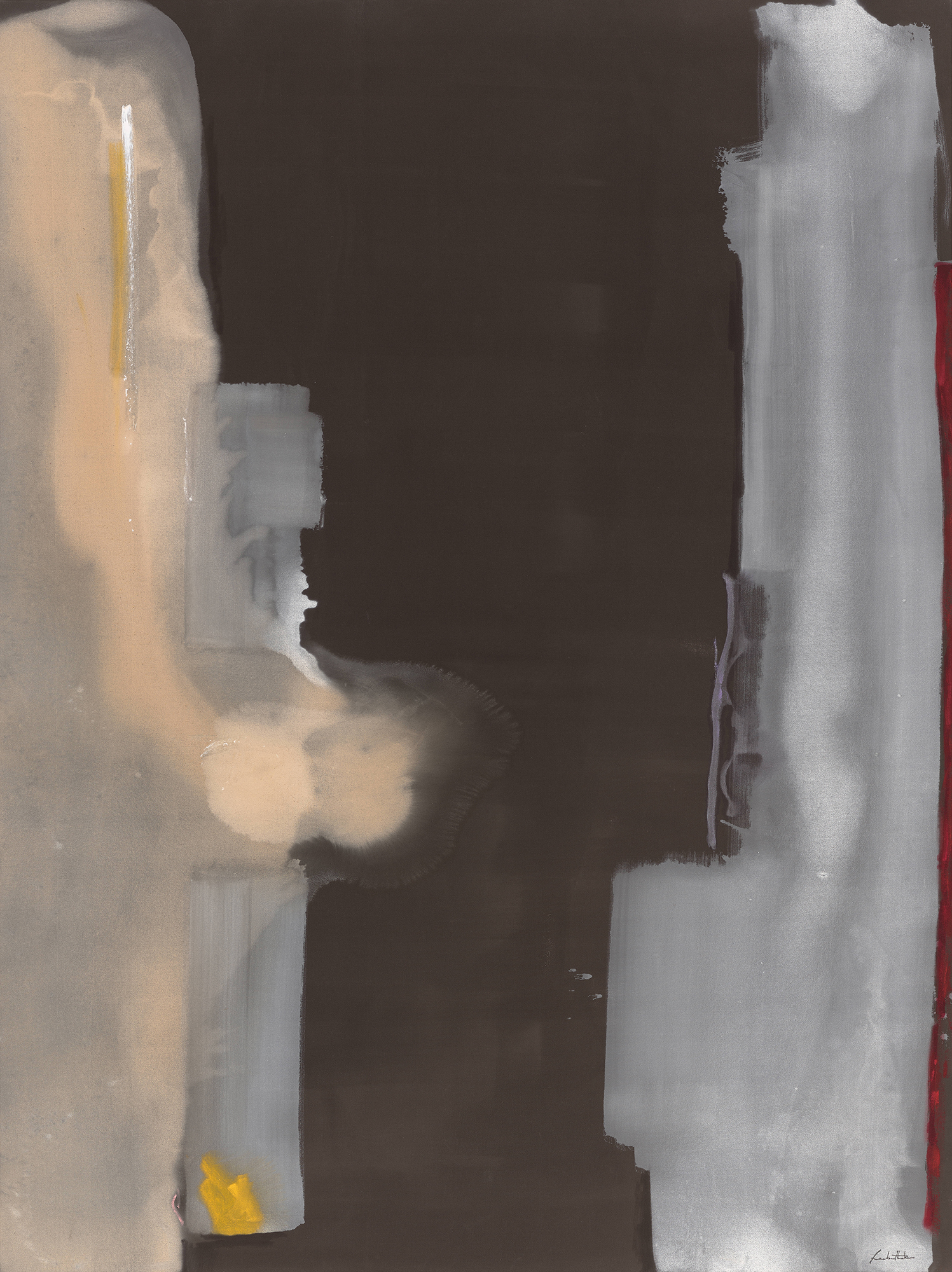
The beauty of Frankenthaler’s works lies precisely in that tension: paint behaves unpredictably, yet the composition never feels careless. Frankenthaler intuitively knew when to intervene and when to step back. Her sureness, what she often called the artist’s “wrist,” kept the work unmistakably her own. “I am essentially true to my own wrist,” she said, continuing by noting that her works are “a continuity with visible changes and developments along the way.”
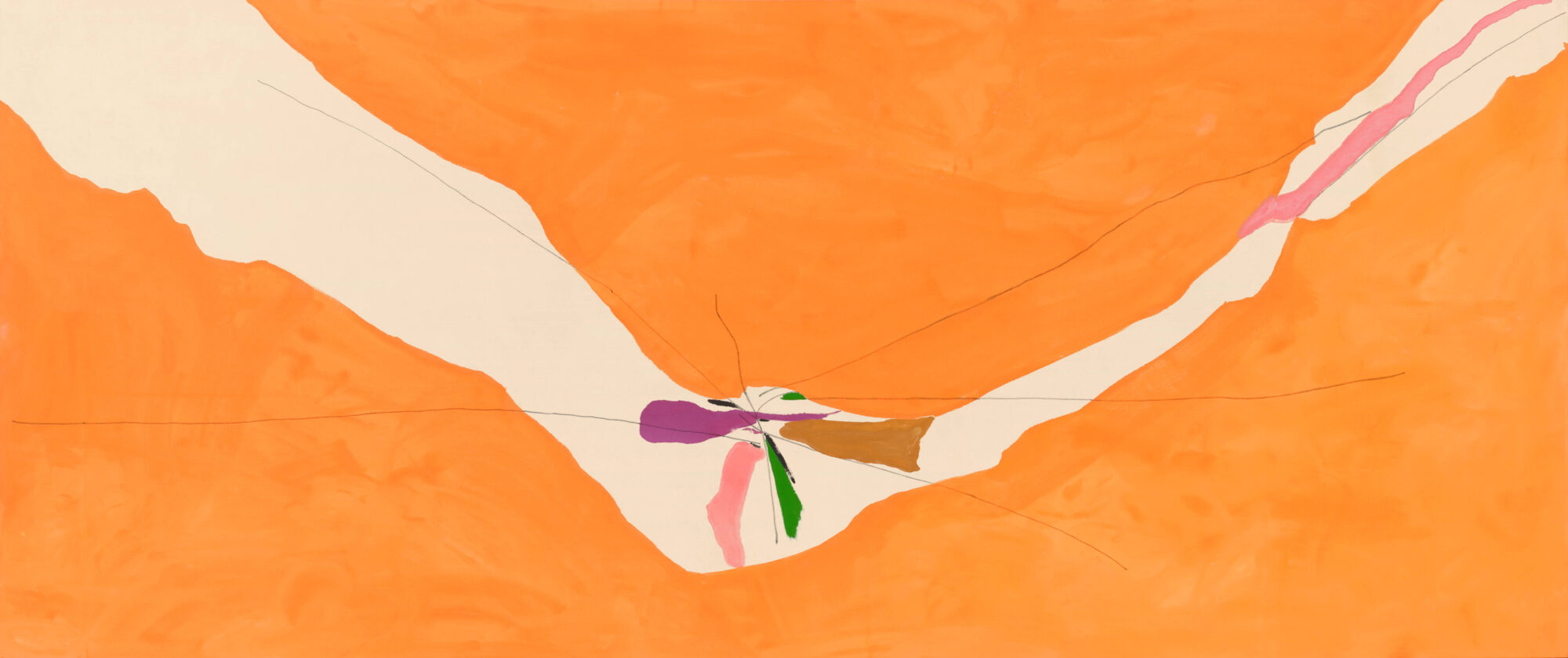
All of the works on display are strikingly large, and the scale is undoubtedly a defining part of the exhibition experience. Standing before these canvases, you step into a world of abstract regions. The paintings seem to extend beyond the wall, surrounding the viewer, embodying Frankenthaler’s belief that her paintings represented “territories.” Notably, you cannot help but note the sheer size of Chairman of the Board (1971)—a vibrant orange piece that engulfs an entire wall. “Big sweep, big scale,” Frankenthaler said, describing the painting. Cracks of raw canvas seep through the orange composition, leaving a vast valley of white across the center. “The piece reminds me of a man trapped in a canyon, caught between beauty and danger, suspended in a crevice carved by time,” said Mary McBeth, beautifully articulating the geographical elements of the painting.
Beyond just Chairman of the Board, Frankenthaler was fixated on creating geographical compositions, inspired by borders and the irregular shapes of states. “I think of my pictures as explosive landscapes, worlds, and distances held on a flat surface,” she said. Mauve District (1966) exemplifies Frankenthaler’s affinity for geography, with its title explicitly invoking territorial divisions. Indeed, the mauve shape resembles the kind of visual marker used on a map to denote a region. “The amount of texture in that strip of purple strikes a balance in the whole painting,” noted Mary McBeth. That texture also grants the painting an almost topographical quality, suggesting elevations and depressions—mountains and valleys—within Frankenthaler’s imagined “district.”
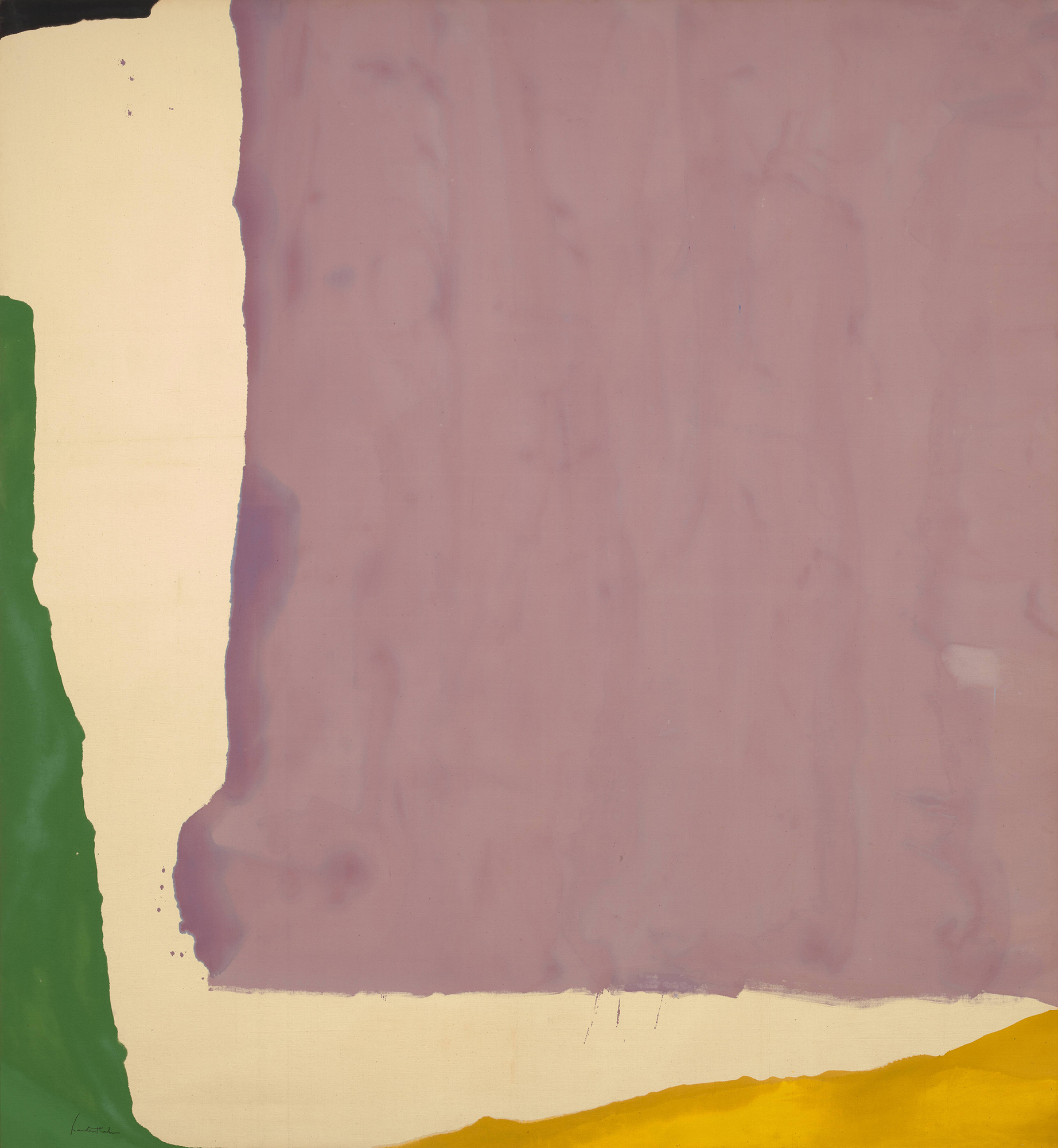
Commune (1969) features a single muted green form set against an otherwise unpainted square canvas, giving it a geographic presence similar to Mauve District. The piece was painted in Provincetown, Massachusetts, where Frankenthaler spent many summers, and where she found much of her inspiration for creating map-like art.

Location consistently informed how Frankenthaler thought about space, scale, and form. New York City, naturally, immersed her in a culture that valued experimentation and ambition, reinforcing her confidence in the unconventional. Her long summers in Provincetown introduced a spatial sensibility; the openness of the landscape and coastline encouraged her interest in shapes reminiscent of “territories.” Travel also played a key role in shaping her work, particularly her exposure to European painting, which provided historical and compositional references that she later reinterpreted through abstraction. Rather than depicting specific places, Frankenthaler allowed the environments she inhabited to influence how her paintings were structured, using real geography as a framework for abstraction.
Several paintings in the exhibit were made with acrylic instead of Frankenthaler’s iconic oil paint. Consequently, the exhibit’s curators emphasizes her evolution rather than treating her technique as static. While Frankenthaler is closely associated with oil paint in her early career, the show highlights her later shift toward acrylics, which allowed for sharper edges and new structural possibilities. Frankenthaler, yet again, was not threatened by challenging precedents, even those that she set. However, after adopting acrylics later in her career, Frankenthaler still remained true to her “own wrist”; a new technique did not mean a new style.
Contrary to expectations of Abstract Expressionism’s bold, colorful intensity, many of Frankenthaler’s works rely on muted, almost subdued palettes, continuing to defy norms. Jacob’s Ladder (1957), an earlier piece in her career, is defined by a subtle palette of soft grays, pale blues, and earth tones that soak into the raw canvas. While much of Frankenthaler’s approach was experimental within New York’s midcentury artistic landscape, the painting’s title and structure draw from a traditional source, José de Ribera’s Jacob’s Dream (1639), which Frankenthaler had seen years earlier at the Prado in Madrid, Spain. The composition developed gradually, with abstract forms loosely organized in order to suggest the ladder motif, translated into shape and color rather than literal Biblical imagery.

The curatorial choices further enhance a sense of immersion. Each painting is framed differently, with frames ranging from gold to mahogany to silver, subtly altering how the work is perceived. Each piece asserts its own presence, reinforcing the idea that Frankenthaler’s career cannot be reduced to a single artistic style.
Whether through unconventional technique, framing, or color palettes, there is a certain level of defiance embedded in all of Frankenthaler’s works. Working within a male-dominated movement, Frankenthaler did not imitate her contemporaries or position herself in opposition to them. Instead, she developed her own way of working, guided by experimentation and confidence in her decisions rather than by prevailing standards. The exhibition shows that her legacy rests not only on technique but in her approach of trusting uncertainty, while remaining firmly committed to her vision.
Ultimately, Helen Frankenthaler: A Grand Sweep showcases the full arc of Frankenthaler’s career—a grand sweep, indeed. From her early innovations using her soak-stain technique, to her later, moodier compositions characterized by acrylics, the exhibition depicts an artist who never stopped questioning not only the artistic “rules” of her time but also her own practice. Take the E or F train down to the MoMA to step into Frankenthaler’s world, to wander its territories, and to trust that the lines will dance in.
Ultimately, Helen Frankenthaler: A Grand Sweep showcases the full arc of Frankenthaler’s career—a grand sweep, indeed. From her early innovations using her soak-stain technique, to her later, moodier compositions characterized by acrylics, the exhibition depicts an artist who never stopped questioning not only the artistic “rules” of her time but also her own practice.