
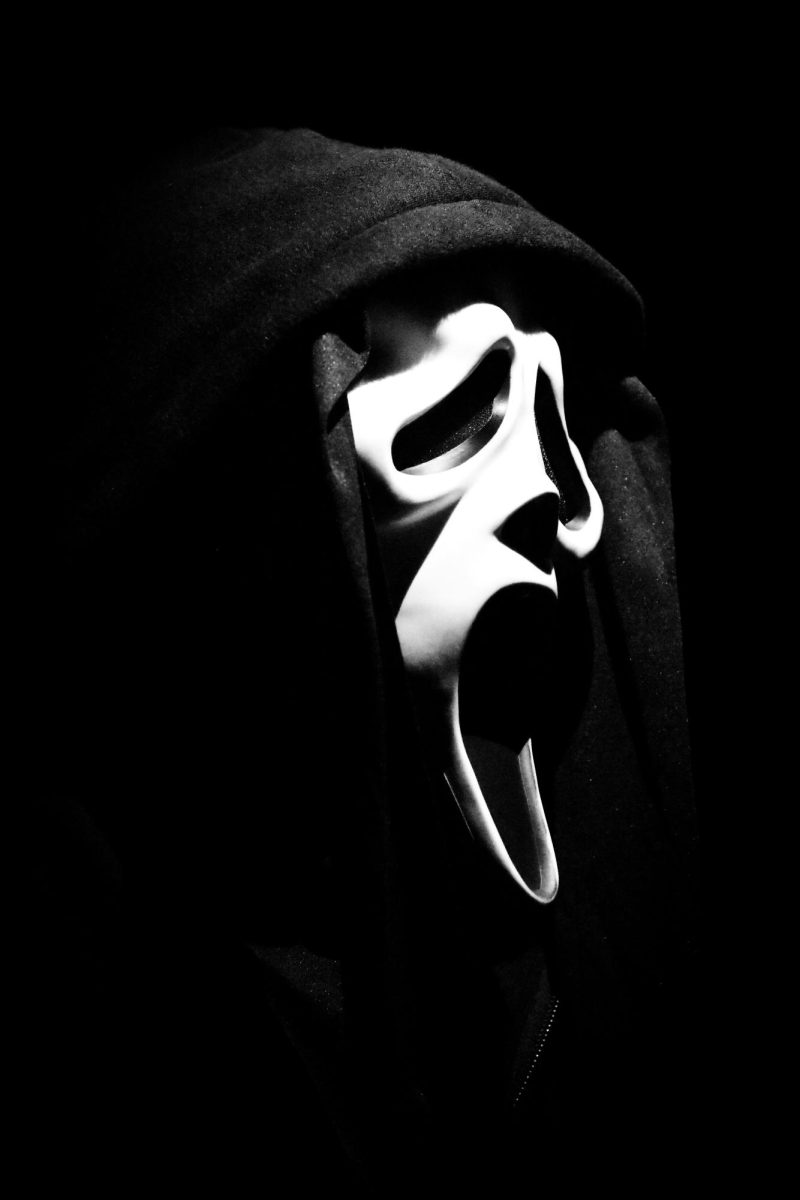
When the lights go out and the movie starts, you scramble to put your phone on do not disturb, and you do not, under any circumstances, talk. Moviegoers who interrupt the film rightfully receive disapproving glares. However, there is one exception to this universal rule: Horror movies.
I first caught Ryan Coogler’s blockbuster, Sinners, at a packed Friday night showing at AMC Bay Plaza in the Bronx. As the vampires plotted their assault, several members of the crowd warned the characters, “Don’t let them in!” and, after the characters ignored the advice the audience continued to shout “Are you crazy? Shut the door!” The audience was emotionally invested in the characters in the face of relentlessly violent vampires, refusing to take their eyes off the screen. This communal experience is what makes viewing horror movies in theaters an essential experience and why the genre remains so resilient.
Recent financially successful and critically acclaimed horror movies are being thrust into the mainstream by a new class of daring filmmakers. For example, A24, a movie production company, has supported many directors – such as Ari Aster who directed Midsommar and Hereditary – who have brought a new perspective to the genre. While horror movies have historically maintained a level of success, new films are breaking creative heights by elevating the slasher flick formula to explore challenging themes such as psychological distress and grief that exist beyond the typical realm of horror.
Leonardo Santana-Zubieta is the Educational Director at the Museum of the Moving Image in Astoria, Queens. Mr. Santana-Zubieta told me that scary movies remain successful because the tried-and-true formula that applies to all variations of horror still works: “It has to be a roller coaster. You need to make people scared, then you need to make them laugh, to kind of bend a little bit. Then you need to keep the audience or your spectators in kind of like suspense and then boom, another big terrifying moment.” Compelling horror movies should evoke suspense and fear in the audience members. The feeling of being on the edge of your seat with no clue what happens next is heightened when shared with a group of people.
Mr. Santana-Zubieta said that the reaction of the theater audience is essential to horror movies success; “I think that horror films will be the last genre to go, because theaters are, you know, becoming less and less popular, because of streaming services, but going to see a horror feeling with your boyfriend or with your group of friends, it’s kind of still a thing, you know? Let’s get scared together.” As movie ticket sales have generally trended downward in the past few years, with movie theater attendance in the United States being 30 to 40 percent below pre-pandemic levels, horror movies continue to connect with audiences and succeed in the box office.
Horror movies also force viewers to connect with ideas that the general public typically avoids talking about. Mr. Santana-Zubieta explains, “Death is like the ultimate taboo. People don’t want to talk about taboos. So death and the mysteries of death, the mysteries of the beyond, it builds up inside as fear, something that we cannot look at and we kind of shut our eyes to. But in a horror movie, you have to deal with it because you know it’s fiction.” Moviegoers use horror movies as a way to cope with the fears of reality. The magic of cinema allows the viewer to see their fears projected on the screen.
Horror movies connect young audiences to these taboo subjects and provide an introduction to film generally. These films give a platform for young filmmakers to push boundaries and take risks based upon what they have already seen on screen. Nick Gaglio, the concierge at the Yonkers Alamo Drafthouse, explains that young artists are inspired by the movies they watched growing up: “a director who loves and reveres Hitchcock… you can tell his [the director’s] fingerprints are all over the movie. They [new directors] will see a horror movie and they’ll be like, ‘oh, this is good, let me research’, and then they’ll generate the next.” Also, slasher films are an accessible and cost-effective format for young filmmakers. For example, The Blair Witch Project, a horror film written, edited, and directed by Daniel Myrick and Eduardo Sánchez, rode to success in 1999 with a flashlight and a paltry budget of about $60,000, not including post production and marketing. The inexpensive minimum budget for horror films allows young artists to create films, regardless of monetary restrictions. The recent success of horror movies, both critically and commercially, are being driven by an investment in original stories. While big-budget event films will always be important to a thriving movie business, Mr. Gaglio explains that conventional popcorn fare no longer guarantees a big theater audience. He says that an increasingly competitive movie business forces studios to take more risks: “Audiences have been hungry for new stories for a while, for sure. Like, that’s clear and common sense…Warner [Brothers] taking chances on Sinners and Weapons specifically…[are] big chances for artists.”

However, all horror movies are not received by audiences equally. The disappointing box office receipts of several horror movies, particularly with respect to sequels and reboots, lend support to Mr. Gaglio’s argument in favor of more unique, artist-driven content. For instance, I Know What You Did Last Summer and M3GAN 2.0, failed to perform well in the box office. Currently, The former was ranked at #51 in profit, with the total gross being $32 million. M3GAN 2.0 was ranked even lower at #58, with the total profit being $24 million. These totals are relative to account budget and other factors, though, still pale in comparison to Sinners (with a total gross of just under $280 million). Artists should be inclined to embrace original ideas, as they repeatedly result in box office success.
However, the theater going experience continues to face unprecedented challenges. The beauty of shared experiences among moviegoers has been disrupted. As technology progresses, people no longer seek entertainment in theaters. People watch movies at home because it’s far more convenient and usually less expensive than seeing the same film a few weeks earlier on the big screen.
While streaming movies presents a convenient alternative, no experience at home emulates the joy of connecting with strangers through the art of filmmaking, which holds strong especially for horror.
The challenge of driving audiences to movie theaters remains key to the future of the film industry. Filmmakers are forced to sell their movies as an “experience” to draw any attention. This often excludes horror movies, as they already are an experience. Recently, the trade publication Variety reported that Cinemark Theaters plan to invest in new large-format IMAX screens to prepare for films where the audience is designed to be engaged, or “event films” like director Christopher Nolan’s upcoming adaption of The Odyssey. Cinemark will build three new 70mm film projection systems and four new IMAX with Laser systems in the United States. Cinemark will also upgrade its remaining 12 IMAX screens to IMAX with Laser, a 4K laser projection system developed to deliver clearer images and better audio.
While big budget “event films” are essential to a thriving film industry, lower budget horror films remain an effective way to reach audiences more reluctant to ditch their home theater for the local cineplex. Should the film industry fail to adapt to the new reality, local movie theaters will quickly let the next generation of film audiences slip away. However, a resurgent horror genre continues to drive audiences off their phones and back in the theater.
“Death is like the ultimate taboo. People don’t want to talk about taboos. So death and the mysteries of death, the mysteries of the beyond, it builds up inside as fear, something that we cannot look at and we kind of shut our eyes to. But in a horror movie, you have to deal with it because you know it’s fiction.”