
Monet never wanted to visit Venice. “I will not go to Venice,” he liked to insist, wary that the city had been painted to exhaustion by other artists. At sixty-eight, he had already found his comfort zone: the gardens of Giverny, the waterways of Normandy, and the city of Rouen. It wasn’t until his wife, Alice Hoschedé, encouraged him that he finally agreed to go to Venice, approaching the trip with caution and curiosity. Once Monet arrived, it was no longer just a place to paint–it became the beginning of a new era of masterpieces.
Terracotta buildings, turquoise water, and rows of gondolas line the streets of Venice. Today, tourists flock to the Grand Canal and the Church of Santa Maria to snap a selfie. But back in 1908, Monet saw these same sights as perfect, picturesque scenes for his paintings. Now, more than a century later, these works rest on the fifth floor of the Brooklyn Museum in the exhibition Monet and Venice on view through Sunday February 1st, 2026, waiting to transport viewers back to the canals and colors that once inspired him.
That transformation unfolds across the canvas. Despite his initial resistance, a quick glance at his work makes it clear that Venice won him over. His paintings reveal a distinct shift in his artistic approach, moving away from sharper forms towards softer outlines and luminous color. As the gallery reminds visitors through Monet’s own words, “I am overcome with admiration for Venice.”

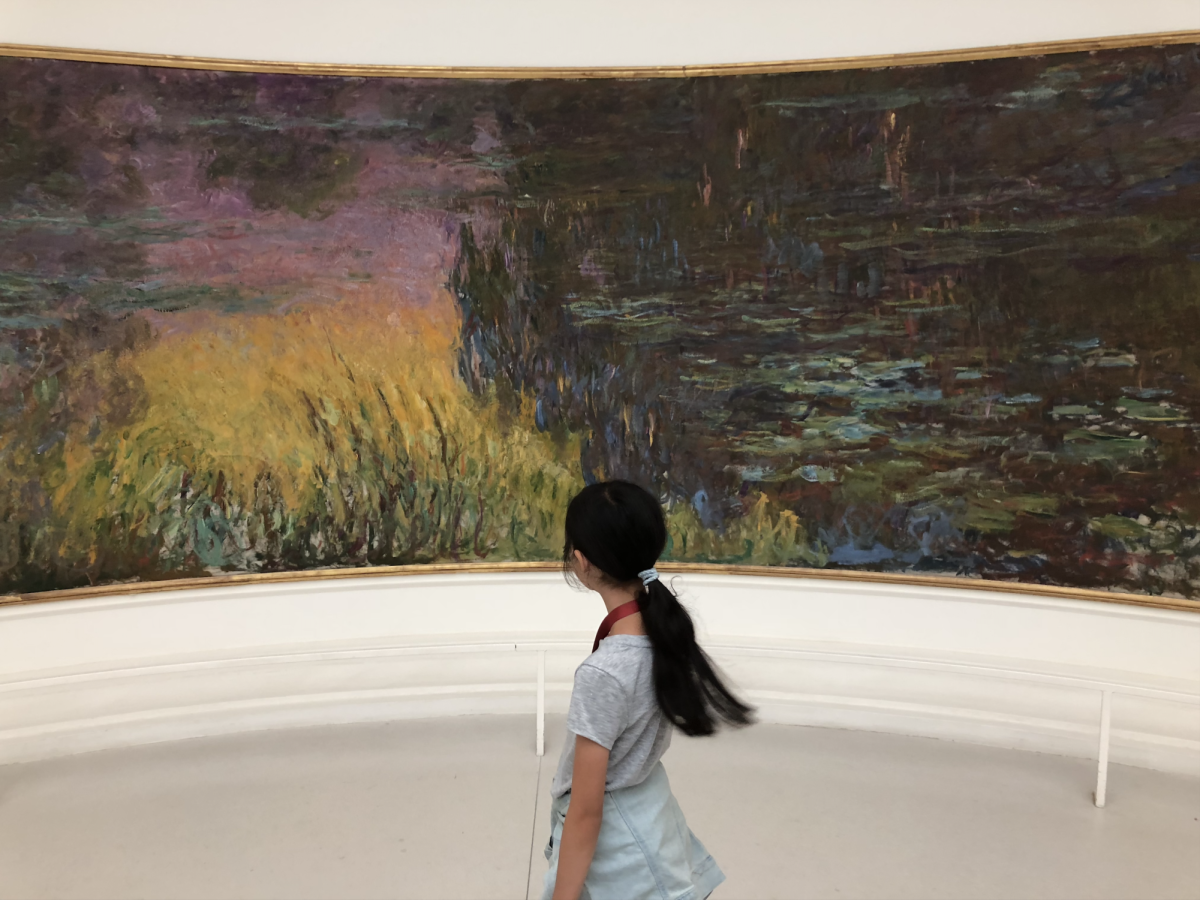
In Monet’s earlier works–such as his landscapes and garden spaces–forms are more clearly defined, and space feels anchored. Light still plays a central role, serving to illuminate recognizable structures. The works housed in Musée de L’Orangerie, particularly the Nymphéas (1897-1899), continue this sense of control. They feel deliberate, emphasizing detail and composition. Each water lily is carefully painted, each plant placed with precision, accompanying the serene stillness of the environment. In Venice, buildings merge into reflections, outlines soften, and water becomes inseparable from architecture. In doing so, Monet presents the city as fluid and unstable–a city shaped by water and time. Today, more than a century later, this vision feels strikingly relevant. Modern Venice is defined by fragility: rising waters, erosion, and the constant struggle to preserve what remains. The city balances precariously between preservation and disappearance, making Monet’s dissolving Venice feel eerily prophetic.
At this stage in his life, Monet had already begun experiencing vision loss. These paintings emphasize a shift in how he perceived the world. Rather than depicting Venice as a tourist attraction, his works convey an atmosphere shaped by time, light, and movement. Instead of freezing a single instant, they evoke a sense of duration–the shimmer of sunlight on water, the subtle shifts in color and reflection–that unfolds over moments and hours. These paintings reflect a late phase of Monet’s career, in which perception matters more than precision, and becomes the true subject of the painting. Monet and Venice come alive not just on canvas but in the very space of the museum, inviting visitors to step into the city as he saw it.
“No one enters Venice as a stranger,” reads the wall copy as you step into the exhibit. You are greeted by a glittering cerulean backdrop lit against the darkness of the room. It feels like a quiet invitation, capturing how Venice can feel familiar even to someone who has never been before. “Walking in, everyone is taking pictures and looking around wide eyed, taking in Venice. It’s just a really exciting opening to the exhibit,” said Sadie O’Connell ’28.
Entering this exhibit feels less like a first encounter and more like a return. Walking through the galleries, you can trace Monet’s journey from doubt to awe, watching him confront, and ultimately embrace, the city he claimed he would never visit.

One of my favorite works in the exhibition is Le Grand Canal et Santa Maria della Salute, in which Monet captures Venice through his signature interplay of light and reflection. The painting seems to glow from within, drawing the viewer into its vibrant scene. The solid architecture of the church and surrounding buildings are dissolved into shimmering reflections on the turquoise water, blending purples, blues, and greens in a haze of color. Sunlight appears to drift across the canvas, animating the scene with subtle movement. Here, the city feels almost fluid, as though water and architecture are inseparable. The subtle, precise brushstrokes and diffused outlines evoke both movement and stillness at once, creating an atmosphere that fully immerses the viewer. Standing close enough to trace individual brushstrokes and read Monet’s signature in the corner, one feels momentarily transported back to the canal itself.
“These landscapes of water and reflection have become an obsession,” proclaims a statement on a blue wall, emphasizing Monet’s fascination with Venice. The absence of people and the soft, shimmering palette give the city a dreamlike, tranquil quality. Water, sky, and architecture dissolve into one another, merging in a luminous haze that creates an otherworldly feeling. This immersive effect proves why Monet’s Venice extends beyond the boundaries of a typical cityscape. After all, the exhibit is called Monet and Venice, not Monet in Venice.
“It is called Monet and Venice for that reason, rather than Monet in Venice, because Venice is a main character,” explained Lisa Small, curator of the exhibit, in an interview with a company called Genelec. The exhibit reinforces this idea by placing Monet’s work alongside that of other artists. While thirty-seven of the paintings are by Monet, the show features more than one hundred works in total, allowing viewers to see how Venice has been imagined, interpreted, and transformed across time and perspectives. Through these varied representations, Venice emerges as more than a backdrop. It becomes a subject with its own artistic identity and presence.

It is for this very reason that Monet and Venice attracts people of all ages. Standing in front of Water Lilies was a baby and a mother, an elderly man in a wheelchair, a group of 20-something girls, and myself, a high school reporter. The painting’s placement–between the final room and the earlier galleries of other artists and earlier Monet paintings–reinforces this moment of convergence, both spatially and temporally. Water Lilies functions as a bridge within the exhibition, connecting artistic periods and perspectives while inviting viewers from different stages of life to pause together. The reflective nature of Monet’s work subtly draws viewers into the scene, making them feel part of the image rather than distant observers. His paintings unite viewers through a shared visual language of light, atmosphere, and sensation. These fleeting impressions transcend age, time, and interpretation. The shared space across generations mirrors the passage of time itself, underscoring how Monet’s vision continues to resonate despite the changing audiences and eras.
In the final room, the paintings are arranged from left to right in order to follow the progression of day, moving from soft morning light to a hazy sunset glow. At first, the differences between each canvas are barely noticeable, with a new figure or passing boat here and there. Yet after tracing the full sequence, the transformation becomes clear: the final painting feels very different from the first. The accompanying music echoes this visual progression, unfolding slowly and fluidly to mirror Venice’s shifting light and atmosphere. Its deliberate pacing, punctuated by moments of near silence, alters visitors’ sense of time, encouraging them to linger with each painting and experience the day’s gradual passage. This careful use of sound establishes a rhythm that parallels the ebb and flow of Venice’s canals, reinforcing Monet’s attention to movement and impermanence. As composer Niles Luther explained in the Brooklyn Museum’s press release, “Blending Italian, French, and American traditions, the composition mirrors Monet’s shimmering, dissolving Venice, transforming brushstrokes into living sound that surrounds the listener with both light and longing.”

The circular layout of the room encourages continuous movement, suggesting how time loops back on itself. Sadie O’Connell ’28 remarked, “I think that I walked around the exhibit at least five times. In a space without a clear beginning or end, it’s as if Monet invites you to enter the same scene again and again.” The details of the final gallery combine to create a multi-sensory experience in which time feels both fluid and cyclical, much like the shifting waters of Venice that Monet loved to capture. Visitors leave the room not with a sense of conclusion, but with the feeling that the city–and the moment–continue beyond gallery walls. A circular bench in the center of the room reinforces this atmosphere: friends talk and laugh, observers pause in quiet reflection, and others simply sit, suspended in the moment.


The exhibition doesn’t end with the paintings: a photo booth and coloring station invite visitors to linger, encouraging them to engage with the exhibition in a more personal way. The photo booth evokes nostalgia, preserving moments that will soon become memories, while the coloring station recalls childhood, allowing visitors to momentarily step back in time. These elements reinforce the exhibition’s theme of fluidity, capable of looping through memory just as easily as it moves forward.
Together, Monet’s paintings, the circular gallery, and the interactive spaces blur the boundary between past and present. Like Venice itself, the exhibit exists in a state of continuity, where moments repeat, overlap, and remain suspended. Long after leaving the fifth floor of the Brooklyn Museum, Monet and Venice lingers as a luminous, immersive vision shaped by color, light, and sensation. As Claude Monet once said, “You can’t come to Venice without wanting to come back.”
Sadie O’Connell ’28 remarked, “I think that I walked around the exhibit at least five times. In a space without a clear beginning or end, it’s as if Monet invites you to enter the same scene again and again.”